Showing posts with label Airport news. Show all posts

Friday, November 13, 2026

Travelore News: New Concourse, Expanded Dining, And More Coming To Southwest Florida International Airport

Southwest Florida International Airport (RSW) is undergoing a massive, multi-phase transformation to accommodate the region's explosive population growth and booming tourism industry. With total investments surpassing the $1 billion mark, the airport's ambitious Terminal Expansion Project is rapidly taking shape. From a sprawling new concourse to revamped dining experiences, here is a look at what passengers can expect in the coming years.

The Centerpiece: The Brand New Concourse E

The crown jewel of Phase 2 of the airport's redevelopment is a sweeping 513,000-square-foot addition anchored by the highly anticipated Concourse E. As travel demand surges in the Fort Myers and Naples areas, this new terminal wing is designed to significantly boost capacity and alleviate gate congestion.

Concourse E will feature 14 new gates, vastly increasing the number of flights the airport can handle simultaneously. Along with the new gates, travelers will find significantly expanded passenger lounging areas, modern gate hold rooms, and enhanced airside improvements designed to make the boarding process much smoother.

Streamlined Security and Better Passenger Flow

Anyone who has flown out of RSW during peak snowbird season knows that security lines can be a pinch point. To address this, the expansion includes a new, consolidated Transportation Security Administration (TSA) checkpoint. Featuring nine lanes, this centralized checkpoint is engineered to streamline screening operations, getting passengers from the curb to their gate with much less friction. Additionally, the project is delivering expanded baggage claim areas and improved roadways and curbside layouts to reconfigure and speed up terminal access.

A Dining and Retail Revival

If you have passed through RSW recently, you may have noticed the permanent closure of several legacy food and beverage concessions in the main terminal, including Nathan's, Quiznos, Shula's Bar & Grill, and Starbucks. While these closures caused a temporary disruption, they are paving the way for a major culinary upgrade.

In total, the airport is adding over 117,000 square feet of new walkways and concession space. The redeveloped areas will accommodate brand-new restaurants and bars in the pre-security area, alongside a vastly expanded retail and food lineup in the new Concourse E and remodeled Concourse C. RSW is even leaning into high-tech convenience, partnering with companies like Evolvending to introduce automated, technology-forward dining locations for travelers who need a quality bite on the go.

The construction is expected to span two to four years, with upgrades being strategically phased to minimize passenger disruption. While there will be some growing pains during the transition—including temporary crosswalk and lane closures—the end result will be a drastically modernized, highly efficient, and much more comfortable Southwest Florida International Airport.

The Travelore Report | www.travelorereport.blogspot.com
X: @TraveloreReport  |  Instagram: @AllenBarkus  |  Facebook: /TraveloreReport  |  Bluesky: @AllenBarkus1102

Friday, January 16, 2026

The New Oneworld Lounges Coming To New York JFK

Cathay Pacific and Qatar Airways will unveil new JFK lounges in 2026.
Cathay's new JFK lounge will boast the 'signature look' already established at The Pier, among others.

Cathay Pacific and Qatar Airways will cut the ribbon on flagship JFK lounges in 2026 – and with modern design, a contemporary menu and no shortage of comfortable seating, they’ll be the perfect pit-stop ahead of flights to Asia and the Gulf region.

The Cathay Pacific New York JFK lounge will be at the transformed Terminal 6, which will host CX flights after the airline moves across from its current home at Terminal 8.

Cathay currently flies out from T8, along with many other Oneworld airlines, and directs its passengers to the shared American Airlines & British Airways lounges.

“But it was always on our wish list to have our own lounge because it’s such an important port,” Cathay Group Chief Customer and Commercial Officer Lavinia Lau has previously told Executive Traveller.

“JFK is a very strategic location (with) a lot of premium passengers flying on that route... so when we decided that we are going to move to this new Terminal 6 and they offered us a location where we can have our own lounge, we basically jumped at the opportunity.”

Cathay is planning a decidedly premium lounge spanning some 10,000ft2 (930m2) – making it close to half the size of The Pier First Lounge in Hong Kong – which will likewise adopt that same elegant “signature” design which has become a Cathay trademark.

Visitors can look forward to familiar elements such as the Noodle Bar, plush furnishings and high-end finishes.
It's not a Cathay Pacific lounge without a Noodle Bar.

However, Cathay has also teased that its JFK T6 lounge “will feature a number of exciting developments that will put it at the forefront of our lounge proposition.”

Also on the move is Qatar Airways, which in the second half of 2026 will relocate from JFK Terminal 8 to Terminal 1 – or “The New Terminal One”, as JFK T1 styles itself.
JFK's The New Terminal One is slated to open in mid-2026.

The Qatar Airways Premium Lounge at New York JFK T1 will be the airline’s first in the USA, sprawling across 15,000ft2 (1,400m2) and boasting direct access from the lounge to the boarding gates used by Qatar Airways flights to Doha.

Visitors can expect everything from “VIP check-in services” and premium à la carte dining to relaxation zones, children’s play areas and even a duty-free shopping outlet.
Qatar Airways is bringing its Doha lounge experience to New York.

However, as with most other Qatar Airways Premium Lounges, this one is expected to be exclusive to business class and first class passengers of Qatar Airways and other Oneworld airlines flying out of T1, with elite-tier frequent flyers being sent to one of the terminal’s independent lounges.

By David Flynn

Tuesday, January 13, 2026

New Airport Plans In The Houston-Galveston Area Abruptly Thrown Out For Good After Officials Make $19.7 Million Decision

Earlier this month, local lawmakers officially closed the book on a decades-long push to bring more flights to a major travel hub.

The Houston-Galveston Area Council in Texas voted to sell roughly 1,400 acres of land to Waller County after decades of planning to build a third airport.

The land was first purchased by the City of Houston in 1986 for $5.7 million, equivalent to about $16.9 million today, according to the Houston Chronicle.

At the time, the massive tract was intended for a proposed Westside Airport, which would be a general aviation reliever facility used for private planes, business jets, and flight training.

The idea has been floated by federal, state, and regional planners since the 1970s as a way to reduce traffic at airports like George Bush Intercontinental.

Planning records from the Houston Galveston Area Council and the Federal Aviation Administration once pointed to the Katy Prairie as the ideal site for a new airport that could ease traffic at Bush Intercontinental and Hobby airports.

Instead of runways and terminals, Waller County officials now have very different plans.

County Judge Trey Duhon said the land will be used largely for parks, flood control, and conservation efforts.

Roughly 600 acres are already protected under a conservation easement.

“We’ll be operating within that, which is fine,” Duhon said, noting the county can still pursue projects such as regional detention systems even with development restrictions in place.

“There’s a large portion where we can’t do much development-wise, but we can use it for detention basins or lakes to help with drainage,” he added.

“That area really needs it.”

The property could also become a cornerstone of Waller County’s first-ever county park system.

“We do not have any county parks at this moment, but with the growth we know is coming, it is important,” Duhon said.

“We hope to make this available for people to enjoy the Katy Prairie, to fish, picnic, maybe even horseback ride.”

The land’s aviation roots stretch back nearly half a century.

Westside Airport Plan Timeline
1980’s – Houston officials propose a major new airport on the Katy Prairie, sparking early backlash..

1988 – Federal wildlife officials warn the site poses serious bird strike risks..

Late 1980’s – Waller County disputes the findings, but the FAA orders a full environmental review.

Late 1980’s/Early 1990’s – Oil downturn slows aviation growth and weakens airport demand forecasts..

1990’s – Environmental concerns and local opposition stall the “Katy Prairie Airport.”.

1998 – Mayor Lee Brown formally ends the airport plan, citing sufficient capacity at existing airports.

2000’s – The land sits unused as the project fades..

2010’s – Efforts to revive the airport resurface but fail to gain traction..

December 2025 – Houston sells the land for $19.7 million, officially scrapping the airport for good..

In the 1980s, city aviation leaders and landowners imagined a sprawling airport with parallel runways, sophisticated landing systems and hundreds of hangars.

Some even compared the vision to Hobby Airport.

But the proposal quickly ran into fierce resistance from Katy-area residents, private airport operators, and environmental advocates.

By the late 1990s, Houston Airport System officials determined the city’s existing airports had enough long-term capacity.

In 1998, then-Mayor Lee Brown formally pulled the plug on the Westside Airport idea, recommending the land be used for wetlands mitigation or sold off if it was no longer needed.

Now, with the sale finalized, the long-dormant airport plan has officially been grounded for good.

Wednesday, November 19, 2025

A Brand-New $1.7 Billion Airport Terminal Is Opening In Pittsburgh Just In Time For Holiday Travel

As the holiday travel season ramps up, one U.S. airport is preparing to open a completely rebuilt terminal. The new terminal at Pittsburgh International Airport (PIT)—which has been years in the making—is designed to ease crowding, streamline security screening, and help travelers move efficiently from curb to gate.

After several trials where locals tested the space from check-in to baggage claim, the new PIT has finally been given an official opening date ahead of Thanksgiving. Here's a look at what travelers can expect from the newly modernized airport and why early testers believe it could rival major U.S. hubs.

Pittsburgh, Pennsylvania, one of the most searched Thanksgiving destinations for 2025, is getting a major travel upgrade this month as the city prepares to unveil its brand-new, $1.7 billion airport. The redesigned terminal officially opens on Tuesday, November 18, just in time for the travel rush.

The new facility is different from traditional airports, according to airport officials. Christina Cassotis, CEO of Pittsburgh International Airport, says the terminal was built with Pittsburghers in mind.
"This is an airport built for Pittsburgh, by Pittsburgh. It improves the passenger experience and ensures this region remains on a global stage," said Cassotis.

Designed collaboratively by Gensler, Luis Vidal + Architects, and HDR, the new terminal focuses on efficiency. Among the improvements are a faster baggage claim, outdoor terraces, and a dedicated welcome area where travelers can meet their family and friends upon arrival. The redesigned terminal is also equipped with a larger and more advanced security checkpoint, reducing the time it takes to travel from curbside to the gates by half.

Visitors passing through the new Pittsburgh International Airport will also notice its beauty. Design elements throughout the terminal emphasize Pittsburgh's geological features.

"Undulating wood ceilings, tree-like columns, and a roofline inspired by rolling hills create a passenger experience that feels efficient and deeply local," wrote Gensler in a news release.

Another notable feature is the new Skybridge, which connects landside and airside areas with colorful lighting that changes throughout the day. In a news release, the airport describes it as "akin to journeying through a Pittsburgh street."

Locals who had the chance to preview the new terminal agreed that it’s both beautiful and a long-awaited upgrade for Pittsburgh.

Locals Say The New PIT Is "The Airport We Deserve"

Ahead of its official opening, Pittsburgh International Airport invited residents to put the new terminal to the test. On September 20, PIT hosted its first full public trial, welcoming more than 300 community volunteers, along with over 100 staff members and airline partners, to experience the terminal exactly as passengers would on its opening day.

This public test allowed participants to move freely throughout the terminal without guidance from operations staff, giving PIT a clearer picture of how the space functions in real-world conditions.

Feedback from the locals has been positive. One trial participant shared their thoughts on Reddit, praising the terminal's design and efficiency.

"The new check-in, security, and baggage claim areas are large and modern, with high ceilings and lots of natural light. Arrivals, departures, and transit are on three levels. There’s clear, helpful signage everywhere that includes TSA wait times. It’s the airport we deserve and will rival that of bigger cities," they wrote.

Other commenters echoed that excitement, saying they hope PIT becomes a hub that rivals those of bigger cities.

https://www.thetravel.com/author/karla-demery/

Monday, August 18, 2025

Inside The $30 Billion Mega Airport Being Built That Will Be Crowned World's Biggest

The new King Salman International Airport in Riyadh, Saudi Arabia, will be the biggest airport in the world when it opens in 2030 - and will serve 120 million passengers every year.
King Salman International Airport in Riyadh is scheduled to open in 2030(Image: Foster and Partners )

Travelers who have journeyed internationally are well aware that some airports are colossal, but a new travel hub under construction in Saudi Arabia might just outshine them all.

Slated for completion in 2030, this airport is projected to cost an estimated $30 billion to construct, and with its six expansive runways and opulent terminal, it's easy to see why.

The King Salman International Airport in Riyadh, the capital of Saudi Arabia, is set to become the world's largest airport upon its opening. It will cover an impressive 57 square kilometers, with 12 square kilometers allocated for retail space.

Fosters and Partners are the architects behind the airport design, which is predicted to be the equivalent of 14,000 football fields. This new travel hub is also expected to generate 150,000 jobs across the logistics and commercial sectors.

The airport is designed to accommodate 120 million passengers annually, a number that could potentially rise to 185 million by 2050.

In a statement, the Saudi Press Agency said: "The airport project is in line with Saudi Arabia's vision to transform Riyadh to be among the top ten city economies in the world and to support
the growth of Riyadh's population to 15-20 million people by 2030."

Currently, Saudi Arabia already boasts the world's largest airport - Dammam Airport - and is undertaking several ambitious projects as part of its Vision 2030.

Construction has already begun on what will be the world's largest building, also located in Riyadh.

The building will tower at an impressive 1,300 ft high and 1,200 ft wide.

The massive development will also house 104,000 residential units, 9,000 hotel rooms, 1 million square feet of office space and 2 million square feet for retail.

A theater and a university will also be located within the building.

https://www.irishstar.com/authors/brigid-brown/

Sunday, December 17, 2023

Spanish Police Arrest 14 Airport Workers After Items Go Missing From Checked-In Luggage

Fourteen workers at one of Spain’s main airports for tourists were arrested on suspicion of stealing items from checked-in luggage, police said Friday.

Police seized allegedly stolen items worth almost 2 million euros ($2.2 million), including around 13,000 euros ($14,000) in cash, from the group of employees at the largest airport in Tenerife, in Spain’s Canary Islands, a statement said. Another 20 airport employees are under investigation in the same case.

The Tenerife South airport handles about 11 million passengers a year, most of them European tourists seeking the pleasant climate of the islands off the coast of northwest Africa.

The investigation began after an increase in passenger complaints about items missing from their luggage, the police statement said.

The thefts occurred as baggage was being placed in the aircrafts’ hold, police said. Inside the hold, the alleged thieves forced open suitcases, took out valuables and shut them again.

Authorities seized 29 luxury wristwatches, 120 items of jewelry, 22 high-end cellphones and assorted electronic devices. The suspects had sold many other items online or in local stores, police believe.

AP

Sunday, December 3, 2023

Travelore News: TSA Is Reimagining Airport Security Checkpoints: First Self-Service Kiosk Opens Next Month

TSA is working on three new security systems that reimagine airport checkpoints, investing in technology to screen more passengers effectively using self-service rather than scaling up the number of screeners the government employs. Passengers will start using the first one beginning next month.

Here’s what they’re working on.

Pod-based design with individual screening consoles, carry-on screening system and flat panel passenger screening

In-motion panel sensors for screening as passengers move through checkpoints​​​​

Integrated carry-on bag conveyance system with security equipment and automated entry and exit doors​​

The first test project is rolling out at the Las Vegas airport. PreCheck passengers will complete the security process independently, using individual consoles or lanes. Passengers will be prompted by machines through each screening step.

Starting in January, PreCheck passengers in Vegas can test out an automated screening lane with carry-on bag conveyance system. They’ll be given instructions by a video monitor. And they’ll go through automated entry and exit doors.

Passengers who don’t pass screening the first time, for instance leaving items in their pocket, the entry door will open back up for them to take those items out and be re-screened. When passengers clear screening, the automated exit door opens and instructs them to gather their belongings.

System To Be Tested In January, Credit: Department Of Homeland Security

TSA describes the project as part of its effort to “increase screening efficiency and improve the passenger experience while keeping a stable number of Transportation Security Officers” or put another way: spend massively on capital equipment to avoid hiring more people.

Willie Sutton said he robbed banks because “that’s where the money is.” But that’s only because he came too early to know about selling new technologies and equipment to the TSA. One after another, generation after generation of the latest TSA-promoted technology eventually ends up mothballed from backscatter machines and Rapiscan and now we have analogic screening devices meant to speed up checkpoints actually slowing them down. Here we have contracts with Micro-X, Vanderlande Industries, and Voxel Radar. That second one can’t be real, right?

Ultimately, TSA is supposed to prevent dangerous items from going through security checkpoints, which requires on focusing on dangerous items and not sci-fi plots. It requires a focus on real threats and not taking scissors away. But that’s not even correct. TSA itself has said there were no known threats against aviation, it’s all hypothetical. And if there were, hardening airport checkpoints just pushes the threat to somewhere else. It doesn’t make people safer, but it prevents TSA from being blamed for the next disaster because it’ll happen outside its area of responsibility.

https://viewfromthewing.com/author/viewfromthewing/

Sunday, October 8, 2023

Philadelphia International Airport To Allow Guests Without Flight Tickets Through Security With New Day Pass

The Wingmate program lets people accompany travelers to their gates and wait for those arriving on domestic flights.


People without flight tickets will soon be able to get through security at Philly's airport. Wingmate, a program slated to begin Nov. 1, will allow people to accompany travelers to their gates, wait for those arriving on domestic flights and shop and eat at the airport.

To participate in the program, those interested can apply online as early as seven days before they visit the airport. The application asks general security questions, including first and last name, gender, date of birth, email and reason for visiting the airport.

Passes will be sent to approved guests at midnight on the day of their visit. People who apply for same-day entrance will receive an email with their application status within 15 minutes.

The program is free but will be limited to 50 people per day, said Heather Redfern, a spokesperson for Philadelphia International Airport.

Guests with Wingmate passes must go through TSA clearance at gates D, E or A-East to access the secure side of the airport.

"They need to show ID and are subject to the same security check procedures as ticketed passengers and cannot bring more than one personal item through security (a purse, small bag or briefcase). Items prohibited by the TSA for ticketed passengers also apply to Wingmate pass-holders," Redfern said.

The pass is good for up to six hours between 6 a.m. and 10 p.m. Pass-holders cannot enter security past 9 p.m.

PHL expects the Wingmate pass to be used by people who are accompanying travelers or picking someone up from the airport. However, it is available to people who want to spend the day at the airport.

Before Wingmate, people who wanted to accompany a traveler to an airport gate would have to contact an airline directly. These services are generally for minors who a parent or adult chaperone would accompany until they board their flight.

Similar day-pass programs are available at international airports in Orlando, New Orleans, New York City and Seattle, The Washington Post reported.

Prior to the Sept. 11, 2001 terrorist attacks in New York City, it was much easier for people to accompany travelers in airports and wait with them at their gates, according to the Associated Press. Security measures then evolved, including the creation of the Transportation Security Administration under then-President George W. Bush.

Source: https://www.phillyvoice.com/staff-contributors/brian-saunders/

Friday, November 25, 2022

Hong Kong Airport Launches New Third Runway

Hong Kong’s airport on Friday officially launched a new third runway which is expected to boost the city’s status as an aviation hub.

The Airport Authority Hong Kong said about 140 flights a day are already using the new runway, which has been in operation since early July.

However, the airport is still using only two runways because its center runway was closed in July for reconfiguration.

The airport is also expanding its Terminal 2 and is building a new concourse and baggage handling system.

Work is expected to be completed by 2024, after which the airport will use all three runways, giving it more flight capacity. The entire project will cost 145 billion Hong Kong dollars ($18.5 billion), according to Jack So, chairman of the airport authority.

“The project was funded from the private market and it doesn’t involve any government money,” So said at the launch ceremony. “This proves that the international financial community, banking sector and funds are confident of Hong Kong and its airport.”

Brendan Sobie, an independent aviation analyst based in Singapore, said that when all three runways are operating, it will allow more planes to land during peak hours, thereby expanding the airport’s capacity.

“You need that capacity, that infrastructure, because you’d start losing out if others have something you don’t have,” Sobie said.

He noted that several other airports in Asia, including in Bangkok and Jakarta, are either working on a third runway or have already added one.

Hong Kong’s additional runway will also facilitate cargo growth.

The city eased pandemic travel restrictions last month, allowing inbound and outbound travel without mandatory quarantine. However, incoming travelers must have a regular COVID-19 test upon arrival.

Saturday, April 9, 2022

The TSA Is Under Fire For This Major Change At Airports

Even though being able to jet off on a much-needed vacation is always an exciting prospect, the process of getting through the airport to your flight is usually not quite as enticing. From long lines and potential delays to expensive food and looming health risks, most would probably prefer to limit their time in the terminal as is. But because of a recent update, your next trip might see even more pre-flight pain points. Read on to find out why the Transportation Security Administration (TSA) is coming under fire from travelers for a major change it's instituting in airports.

New luggage scanners are causing delays at security checkpoints in airports.

Thanks to everything from severe weather to staffing issues, delayed or canceled flights have become more common as the travel industry still struggles to recover from the effects of the COVID-19 pandemic. But travelers are now reporting experiencing delays before they even reach their flights because of an update to the security screening process being rolled out at airports across the U.S. by the TSA, according to travel news outlet The Points Guy.

The latest issue is caused by the implementation of new computed tomography (CT) scanning machines that are now being used to check all carry-on luggage at checkpoints. According to the agency, the updated scanners should allow travelers to pass through security more quickly by allowing them to leave certain items in their bags. But unfortunately, the process appears to be turning what can already feel like a long and drawn-out process into an even slower experience.

"I think it took about ten minutes to screen ten people…If not longer," traveler Joelle Erickson wrote in a post to a Facebook group hosted by The Points Guy. "The people in front of me were trying to contact their family further back in line to warn them of how slow the machine was."

The TSA says the machines should eventually make the security process easier.

The new machines are part of a project launched by the TSA to update and modernize technology at security checkpoints across the U.S., The Points Guy reports. After initially spending $200 million on an order of new scanners in 2021, the agency announced in March that it had authorized a $781.2 million contract for nearly 1,000 machines that airports will likely install by this summer.

According to the TSA, the new machines allow agents to scan luggage without the typical hassle of removing certain items. "CT technology provides enhanced detection of threat items. Like existing CT technology used for checked baggage, the machines create such a clear picture of a bag's contents that computers can automatically detect explosives, including liquids," the agency explains on its website. "In the future, the goal is to keep laptops and 3-1-1 liquids inside of the bag during checkpoint screening. Under current screening procedures for this technology, laptops are allowed to remain inside the bag for screening."

Put more simply, the scanners will provide 3D imagery to security personnel and ideally cut down on the need for bag checks. "It's much like the CT scan machines you see at the hospital," TSA southeast spokesperson Mark Howell told The Points Guy earlier this year. "And the difference in security is really [like] the difference between a map and a globe."

The TSA admits that training issues are causing security check delays at some airports.

Unfortunately, while officials hope the new technology will eventually smooth out and expedite the security screening process, the rollout is creating some issues for travelers as the current advanced technology (AT) machines are replaced. Staff from The Points Guy have reported delays at airports across the U.S., including San Diego International Airport, Denver International Airport, Charlotte Douglas International Airport, and Boston Logan Airport.

"As with any new technology, there is a learning curve for officers; as their proficiency increases, there is an expectation throughput will meet and exceed existing AT systems," a spokesperson for the TSA told The Points Guy in an email.

Here's how you can still get through airport security quickly and easily.

Because of the potential for delays, some experts warn that travelers should try to arrive at the airport a little earlier than usual as agents get used to the new process. Travelers can also opt for an expedited experience by signing up for TSA PreCheck, which allows passengers to use a dedicated lane, keep liquids and laptops in their bags, and leave their shoes on their feet during the screening process, Travel + Leisure reports.

But even though the new machines may be making some travelers frustrated, others still see the slow-down as a fair trade-off for simplifying the security process. "As a parent traveling with iPad, snacks, and wet wipes, I loved the new machine," traveler Matt Teichmann posted in The Point Guy Facebook group. "I'd rather it take a little longer and not have to do all that unpacking!"

Source: ZACHARY MACK

Saturday, September 11, 2021

$6 Billion Project To Improve O’Hare Runways Completed

CHICAGO (AP) — Government and airline officials gathered on Thursday to mark the completion of a $6 billion modernization project to untangle the jumble of runways that for decades made flying into and out of Chicago’s O’Hare International Airport feel like a downtown traffic jam at rush hour.

During a ceremony at the airport, Chicago Mayor Lori Lightfoot said the 16-year O’Hare Modernization Project (OMP) to extend two existing runways and build four new ones running side by side has made flying into and out of one of the busiest airports in the world much simpler.

“With the correcting of the runways and making them run parallel, the OMP has resulted in a 64% reduction in delays over the life of the project,” Lightfoot said of the project, which also added two new air traffic control towers and relocated several facilities.

The changes are welcome improvements for an airport that for years ranked among the country’s worst for on-time departures and arrivals.

The modernization project is part of a larger $8.5 billion project — including the $6 billion spent on the new runways and other improvements — called O’Hare 21 that will include the construction of a massive O’Hare Global Terminal.

“This means more passengers and cargo running through O’Hare, and that means more tourists and more businesses for Chicago and the Midwest,” said U.S. Rep. Raja Krishnamoorthi, whose suburban Chicago district includes the O’Hare runways.

The projects were paid for largely with a mix of airport revenue bonds, passenger fees and federal grants, with airlines having paid the debt service on the bonds. During Thursday’s ceremony, U.S. Sen. Richard Durbin (D-Ill.) said that after contentious battles that extended from courtrooms to Congress, the federal government’s share of the funding has been about $2.5 billion.

Tuesday, May 25, 2021

New $1.7B Los Angeles International Airport Concourse Opens

LOS ANGELES (AP) — A massive new $1.73 billion concourse with 15 gates opened Monday at Los Angeles International Airport.

Known as West Gates, it will serve both international and domestic flights.

“This is a big day in a big city that’s building out a big new infrastructure,” Mayor Eric Garcetti said during an opening ceremony.

The 4½-year construction project was part of a $14.5 billion airport modernization project.

Located just west of the Tom Bradley International Terminal, the five-level, 750,000-square-foot (69,677-square-meter) West Gates concourse is 1,700 feet (518 meters) long.

Officials said it is based around a digitally based travel experience, including biometric boarding gates, thousands of places to plug in and access wireless internet — with 5G later this year — and touchscreen kiosks.

There are two nursing rooms, three play areas for children and a relief area for service animals.

The airport described the West Gates’ baggage handling and boarding system as the most advanced in the U.S.

The airport improvement project involves all of the airport’s passenger terminals. New facilities include an automated people mover train, a consolidated rental car facility and a parking structure for 4,300 vehicles.

And a new metro station will at long last connect the airport to Los Angeles County’s light rail system.

Tuesday, September 29, 2020

Israeli Instant COVID Gargle Test Set To Deploy In European Airports

Inventors in self-service spit test have signed a deal with airport security giant to pilot tech on the continent, predict it will be a ‘de facto solution for air travel’


A mask-wearing traveler looks at his cellphone in front of a flight panel (Vergani_Fotografia; iStock by Getty Images)

 A new made-in-Israel gargle test for coronavirus is being deployed in European airports, after a leading aviation security company threw its weight behind the tech.

A freshly inked agreement will lead to the tests being piloted in two European airports within days or weeks, and comes as pilot programs for the tests are already underway in 12 hospitals internationally, Eli Assoolin, who led the development team, told Times of Israel.

The SpectraLIT test, which eliminates the need for swabbing and lab processing, works on a self-service basis, with passengers simply asked to gargle with 10 milliliters of a special mouthwash, and then spit into a tube. “It will prove no more inconvenient than fingerprint checks,” said Assoolin.

In the initial pilot phase, a passenger who tests positive will be sent for a standard swab test.

The test, developed by Assoolin’s company Newsight together with Sheba Medical Center under the freshly formed Virusight Diagnostic, is being taken to airports by ICTS Europe, a security company that operates in more than 120 airports across 23 countries.

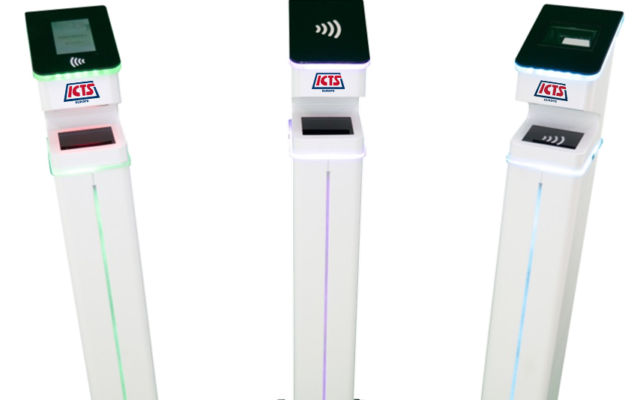
The self-service passenger stands in to which Virusight Diagnostic and ICTS Europe plan to integrate Israeli-developed gargle COVID-19 tests for airports. (courtesy of ICTS Europe)

ICTS has just agreed to pilot the SpectraLIT, and signed a letter of intent declaring that it will roll it out internationally if it proves effective, once regulatory approval has been received.

“We think our solution is going to be the de facto solution for air travel,” Assoolin told The Times of Israel, saying he foresees millions of his tests used over the coming months.

Illustrative: A woman gargles while using mouthwash from a glass (Tharakorn; iStock by Getty Images)

He said he expects to see the screening method deployed quickly in two European airports, integrated into self-service stands that ICTS already has for checking body temperature and printing boarding passes.

“Once the device proves itself in one airport we can — within a month including training and everything — take it to dozens of airports,” he stated.

Oren Sapir, ICTS Europe’s president and CEO, commented: “As travel restrictions are gradually lifted, innovation and technology will continue to be central to the industry’s recovery, and so we are proud and extremely pleased to join forces with Virusight to unveil SpectraLIT.”

Left to right: Eli Assoolin, CEO of Newsight, Professor Eli Schwartz of Sheba Medical Center and Eyal Yatskan, co-founder of Newsight, with the machine for testing gargle samples (courtesy of Newsight)

The tech has been trialed on 400 people at Sheba, and showed around 95% accuracy.

“We chose Virusight due to its proven diagnostic track record,” said Sapir.

Regular tests require swabs from the nose or throat and time-consuming lab processes carried out by trained staff. SpectraLIT relies on artificial intelligence to interpret a reading of a gargle sample.

It shines light through the sample and onto a special chip. Part of the light is absorbed, and the rest is captured by the sensors. The process is known as determining the sample’s spectral signature: matter reflects different light signatures, depending on its composition.

An airplane takes off over airport control tower at sunset (satit_srihin; iStock by Getty Images)

Artificial intelligence tools have made it possible for the developers to build a model for the mouthwash signature from a coronavirus-positive person, as opposed to those from non-infected individuals.

Sheba’s chief innovation officer Dr. Eyal Zimlichman described the new agreement as an “important milestone” for Virusight and said: “Digital health will transform healthcare, and this is yet another example of leveraging artificial intelligence technology to mitigate COVID-19.”

Source: https://www.timesofisrael.com/israeli-instant-covid-gargle-test-set-to-deploy-in-european-airports/

Saturday, November 30, 2019

Berlin’s Much-Delayed New Airport To Open Oct. 31, 2020


BERLIN (AP) — Berlin’s much-delayed new airport has a new opening date: Oct. 31, 2020. That is nine years later than the date envisioned when construction started in 2006.

The new BER airport has defied all clichés of German efficiency: construction problems and technical delays saw the date pushed back repeatedly — most dramatically in 2012, when the opening was canceled just four weeks before it was supposed to happen.
The delays have left Berlin relying on two small, aging and increasingly crowded Cold War-era airports: Tegel, which served West Berlin, and Schoenefeld, just outside the city limits, which was communist East Berlin’s airport.
The operator had previously said that it aimed to open the new airport next October but had stopped short of committing itself to a specific date.
Airport boss Engelbert Luetke Daldrup said that the move to the new airport will be phased.
Flights to and from Tegel, the busier of the existing two airports, are scheduled to end on Nov. 8, 2020, but airlines will continue to use the existing Schoenefeld terminal, across the tarmac from the new airport, for some time.
“We still have 11 months of hard work in front of us,” Luetke Daldrup said. A test phase of systems at the airport will run from April to October, “then BER can be opened safely and reliably,” he added.

Friday, July 20, 2018

DFW Airport To Change Pick-Up And Drop-Off Rules At Terminals


Active loading and unloading designation to improve customer service and safety


DFW AIRPORT, Texas -- Dallas Fort Worth (DFW) International Airport is changing curbside areas at all five terminals to active loading and unloading zones, part of a comprehensive program designed to improve the flow of traffic and enhance safety and security for customers, employees and business partners. DFW has added nearly 1,200 one-hour parking spaces and will encourage customers to use the terminal parking garages at no extra cost when picking up or dropping off passengers. Full enforcement of active loading and unloading zones will begin Sept. 8.
"There are more vehicles than ever at the Airport, and we want to keep traffic moving, while providing safer access to our terminals," said Sean Donohue, CEO of Dallas Fort Worth International Airport. "These necessary changes will improve the overall customer experience as it relates to traffic flow, efficiencies and ease of navigation."
Signs indicating the new policy will be posted at the terminal curbsides in July, designating the areas for active loading and unloading only. Previously, customers could idle in attended vehicles along the curbside, while waiting for arriving passengers. DFW Department of Public Safety and Parking teams will inform customers of the change throughout July and August, directing parked or standing vehicles to nearby terminal garages with 1-hour and 2-hour parking zones.
Comparing February 2015 to 2018, vehicle traffic for the month increased by more than 245,000 visits at DFW. At peak times, there can be congestion along the curbs at all terminals, impeding the flow of traffic. The changes reduce the number of vehicles on the upper level and will bring DFW in line with other large airports which have not allowed curbside parking since 2001, including Dallas Love Field.
In 2019, after active loading and unloading zones are implemented, the Airport will shift some transportation services to upper and lower concourses, based on customer demand.
To support the new parking policies, new signs and enforcement will be implemented in several phases. DFW Airport is committed to communicating those changes with customers, the community, and its stakeholders in a clear and timely manner.
About Dallas Fort Worth International Airport:
DFW Airport warmly welcomes more than 67 million customers along their journey every year, elevating DFW to a status as one of the most frequently visited superhub airports in the world. DFW Airport customers can choose among 176 domestic and 57 international nonstop destinations worldwide. DFW is elevating the customer experience with modernized facilities and updated amenities. Centered between its owner cities of Dallas and Fort Worth, Texas, DFW Airport also serves as a major economic generator for the North Texas region, producing over $37 billion in economic impact each year by connecting people through business and leisure travel. For more information, visit the DFW website or download the DFW Mobile App for iOS and Android devices.
Follow @dfwairport on Facebook, Twitter, Instagram, and Pinterest


SOURCE DFW International Airport

Friday, April 22, 2016

Travelore News: Dallas Fort Worth International Airport Opens Renovated Section Of Terminal E, Gates E11-17


New concessions, state-of-the art terminal parking facility added to Terminal E, next construction phase to renovate final 9 gates 
 Dallas Fort Worth International (DFW) Airport has opened a newly renovated section of Terminal E, in time for the upcoming summer travel period. The latest upgrades to Terminal E include renovations to gates E11 through E17 along with the corresponding airline ticketing hall for Alaska Airlines and Delta Air Lines.  The improvements, part of DFW's Terminal Renewal and Improvement Program (TRIP), also include the baggage claims at E13 and E14 and a security checkpoint (E16 opening May 15). The completion of phase three of the Terminal E project also coincides with the opening of an adjacent, new 1800-space parking garage that features DFW's Parking Guidance System technology.
Dallas Fort Worth International Airport opens a newly renovated section of Terminal E, including six new gates and new restaurants and shops.
"When our customers arrive at Terminal E, they will certainly notice significant progress and activity as a result of our TRIP renovations," said Khaled Naja, DFW Airport's executive vice president of Airport Development and Planning. "Our focus has been on delivering a superior customer experience – from easily finding a parking space with our parking guidance system to convenient check-in processing and a variety of concession options before boarding." 

A pre-security concession, Southwest News, near baggage claim E13/14 opened today, and new gate amenities include upgraded seating and charging tables for passengers. In addition, passengers now have more choices in food, beverage, retail and service offerings with the following concessions:
  • E11 – Love Shack (Chef Tim Love's Fort Worth Burger Joint)
  • E12 – Marshall-Rousso (Retail - Women's Accessories)
  • E13 – Sonny Bryan's (Dallas Smokehouse Barbecue)
  • E15 – Texas Marketplace (Texas themed gifts)
  • E16 – InMotion Entertainment (Retail – Electronics)
Phase four of the renovation work at Terminal E begins next month, renewing gates E2 through E10, adding more concessions and enhancing an additional section of terminal parking. This final phase of construction is expected to be complete late 2017.

During construction, DFW Airport is recommending passengers departing from Terminal E to arrive early and to review available Airport parking options and terminal navigation before arriving onsite. The portion of the parking garage directly across from gates E18 through E32 has closed for renovations and will reopen in 2017. 

Onsite parking will remain available in the garage across from gates E2 through E10 and serve as overflow. Passengers parking in this lot will need to use an outdoor walkway to enter the terminal at E14. Additional Terminal Link shuttles also will be available to mitigate construction efforts and deliver passengers to operational sections of Terminal E. The Airport offers a variety of parking services, including valet at Terminal E and Express Parking with shuttle pickup and convenient drop off at terminal entrances.
"We understand renovations can sometimes cause inconvenience for our customers, so we're working to help ease this transition while work continues on terminal enhancements, new concessions, amenities and parking facilities," Naja said. "With the completion of TRIP, DFW Airport customers will enjoy some of the most convenient, enhanced airport terminals in the world."
About Dallas Fort Worth International Airport:

Dallas Fort Worth International (DFW) Airport warmly welcomes more than 64 million customers along their journey every year, elevating DFW to a status as one of the most frequently visited superhub airports in the world.  DFW Airport customers can choose among 154 domestic and 56 international nonstop destinations worldwide.  DFW is elevating the customer experience with modernized facilities and updated amenities, as well as through a $2.7 billion Terminal Renewal and Improvement Program to renovate its four original terminal buildings.  Centered between its owner cities of Dallas and Fort Worth, Texas, DFW Airport also serves as a major economic generator for the North Texas region, producing over $37 billion in economic impact each year by connecting people through business and leisure travel. For more information, visit the DFW website, download the new DFW App for iOS and Android devices, or follow DFW on social media.
Follow Dallas Fort Worth International Airport On:
Twitter.com   | YouTube.com   | Facebook.com

Wednesday, September 17, 2014

Travelore News: Dubai Makes Plans For World's Biggest Airport, At $32 Billion

AL MAKTOUM INTERNATIONAL AIRPORT
AP
DUBAI, United Arab Emirates (AP) — Dubai's ruler has endorsed a $32 billion expansion plan for the city's second airport that officials envision will eventually become the world's biggest, the Middle Eastern commercial hub's airport operator said Monday.
The approval sets in motion a vast building project that aims to give the airport known as Al Maktoum International at Dubai World Central the capacity to handle more than 200 million passengers per year.
The first phase of the expansion alone aims to build enough runway and terminal space to handle 120 million passengers a year and 100 of the double-decker Airbus A380 jets at any given time.
The world's busiest airport, Hartsfield-Jackson Atlanta International Airport, handled 94.4 million people last year.
Once complete in six to eight years, the new Dubai airport will boast five parallel runways spaced far enough apart so they can all be used at the same time and spread over 56 square kilometers (22 square miles), according to the state-backed airport operator Dubai Airports.
The airport opened for cargo flights in 2010 in the desert south of central Dubai. It received its first passengers in October at a single terminal that is mainly used by smaller airlines and low-cost carriers.
The currently larger Dubai International Airport is by far the Mideast's busiest airport and is home to Dubai-based Emirates, the region's largest carrier. It was the world's seventh busiest airport last year, handling 66.4 million passengers.