Showing posts with label Day trips. Show all posts

Monday, September 12, 2016

‘The Beatles Have Got A Lot To Answer For In Liverpool’


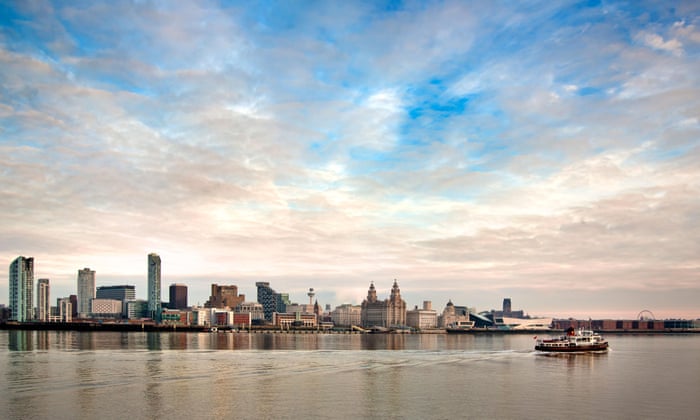
Ferry good … the Liverpool waterfront, including Pier Head. Photograph: Alamy

Roger Appleton, the director of a new documentary about Liverpool’s music scene – and not just the Fab Four – is inspired by the romantic and beautiful place he sees as ‘the least English of English cities’
Liverpool’s music scene is like the tide of the Mersey. It rolls in and brings fantastic songs and bands and then, for a little while, there’s a lull as it goes out. There’s almost a rhythm to its success.
I think many of the songs written here are inspired by the light and the river. Listen to a band like Echo and the Bunnymen and there’s often a lilting, lyrical feel to their tunes; compare it with a Manchester band of a similar period, like New Order, and their music is mechanistic, almost industrial.

Roger Appleton, director of Get Back.
Pinterest
 Roger Appleton, director of Get Back

To me Liverpool is the least English of English cities, and it’s one of the reasons I love living here. The population in the 1840s was relatively small (around 250,000) but from 1840-50 almost 1.3 million Irish people passed through here. Many moved on to the US or inland but the fact there were so many meant that by the 1860s you could walk around sections of the city and think you were in Ireland.


The best way to see the sights is to be a flâneur. I love this idea of strolling around taking in the buildings and atmosphere of a place. My partner has lived here all her life and I’ve been here for more than 30 years and we still get enormous pleasure from walking around. It can be the Victorian grandeur of the business district around Dale Street and Castle Street or the splendour of the Georgian Quarter around Hope Street, the street that runs between the city’s two cathedrals.
But if you want a proper sight to tick off the list, it has to be the Walker Art Gallery. I think it’s the best collection of paintings outside London. There are fantastic works from the early Renaissance period and because of the gallery’s association with the John Moores Painting Prize, there are great pieces by David Hockney, Peter Doig and Lucian Freud.

The Walker Art Gallery, home to the best collection outside London.
Pinterest
 The Walker Art Gallery, home to the best collection outside London. Photograph: Olaf Protze/Getty Images

St George’s Hall is one of the most magnificent buildings in Britain – though one of my friends once referred to it as “our village hall”. It’s a Grade-II listed neo-classical hall that was built in the early 1800s for musical events, as well as being a civil and crown court.
Last year, a set of terraced streets in Liverpool won the Turner Prize. Just across the road from Ringo Starr’s childhood home on Madryn Street are four streets of fantastic Victorian houses. They had been allowed to deteriorate during the 1980s and 90s and the council wanted to knock them down but local residents fought to save them. The residents worked on a renovation programme with an art and architecture collective called Assemble, from London, and last year Granby Four Streets won the UK’s most prestigious art prize.
The Beatles have a lot to answer for. That’s the opening line of my documentary. The Beatles’ story has been told so many times and I thought it would be more interesting to highlight some of the other fantastic music made in Liverpool before, during and after the Beatles. It’s important not to overlook how good some of this stuff was. I wanted to put the Beatles in the context of all of the music that came out of Merseyside.

An art installation of suitcases on Hope Street, in Liverpool’s Georgian Quarter.
Pinterest
 An art installation of suitcases on Hope Street, in Liverpool’s Georgian Quarter. Photograph: Alamy

For years after the Beatles’ peak, bands in Liverpool were almost afraid to write songs. Pete Wylie from Wah! said: “John Lennon cast a shadow over me.” It wasn’t until the early 70s that more bands started to write their own stuff – Deaf School in particular. Eventually, the floodgates opened and that led to the scene that developed around Eric’s Club on Mathew Street, with Echo and the Bunnymen, OMD, Teardrop Explodes and, ultimately, Frankie Goes to Hollywood.
The Music Room has been a great addition to the city’s music venues. It’s an intimate space, opened last year with a capacity of 160-250, and is built on to the back of the Philharmonic Hall. It sees jazz and folk bands, world music, some blues, and while they’re not often the sort of performers who’d sell out a 1,000-seater venue, they are at the top in terms of talent.
The quality and diversity of bands at the Caledonia is extraordinary. I don’t know how this pub-venue manages it but there’s great live music, for free, five nights a week. There’ll be jazz, including the Blind Monk Trio, a fantastic Irish band called Saltcutters play regularly, the pub hosts Cajun sessions and you might also catch the Loose Moose String Band with their 1930s swing tunes.

Live music at the Cavern Club
Pinterest
 Live music at the Cavern Club. Photograph: Christopher Furlong/Getty Images

Tony Benn told me a great story about coming to give a talk at the Philharmonic Hall. He said that he caught the train to Lime Street station and not knowing how to get to the hall asked people at a bus stop for directions. He said that not only did a man walk him to the hall but that by the time he arrived he’d also learned something about Rosa Luxemburg that he didn’t know.
Stand with your back to Princes Park gates and look down Princes Avenue – that’s my favourite view of this city. Princes Avenue is an extremely grand Victorian boulevard with a wide, green, central reservation, which is full of trees. It is lined with the most beautiful Victorian houses; you can almost imagine nannies in the 1890s wheeling their prams up and down that central reservation.
 Get Back, the Story of the City that Rocked the World, is out now on DVD


Thursday, September 24, 2015

The Vatican By Train: A New Kind Of Papal Visit

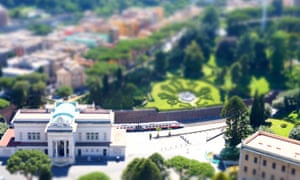
Panoramic (tilt-shift) view of the Vatican City and train station.
Panoramic (tilt-shift) view of the Vatican City and train station. Photograph: Alamy
Visitors can now combine a tour of the Vatican with a wander around the pope’s summer palace – travelling by the Pontiff’s railway. Our writer was among the first passengers on board
Things don’t come more Da Vinci Code than a ride on the Pope’s railway – the centrepiece of a new tour launched by the Vatican Museums this month. The train departs the Vatican City’s private railway station – a marble building in the shadow of St Peter’s basilica – on a stretch of track that originates in a tunnel dug into the hillside beneath the Vatican Gardens. It travels along the 300-metre Vatican railway line – the shortest in the world – into Rome, then rumbles on to the Pope’s sumptuous Castel Gandolfo summer palace in the Alban hills south of the city.
This day-long excursion combines existing tours of the Vatican Museums and gardens with a tour of the grounds of the Castel Gandolfo. And for the first time the locations are linked by a ride on the Papal railway. At €40pp, it’s also the cheapest way to explore the papal properties: a guided tour of the museums and gardens in the Vatican alone costs €32.
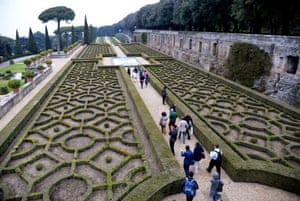
People visit the gardens of the pope's summer residence, Castel Gandolfo, south of Rome.
 People visit the gardens of the pope’s summer residence, Castel Gandolfo, south of Rome. Photograph: Vincenzo Pinto/AFP/Getty Images
I joined the tour on its inaugural Saturday, my pre-booked ticket letting me dodge the queue that, at 8am, already snaked around the walls of the Vatican City. The first two hours are unchaperoned, so my recommendation would be to avoid the Sistine Chapel cattle-run and visit the quiet contemporary religious art galleries, which include works by Dali and Matisse.
The guided walk through the Vatican gardens that follows is the perfect antidote to the rammed museums. It meanders between fountains and grottos, past the monastery where the retired pope, Benedict XVI, lives, and on to Stazione Vaticana, the city’s only station.
The train – ordinary Trenitalia rolling stock, sadly, not the Papal steam train – takes an hour to reach the town of Albano Laziale, where a shuttle bus takes passengers to the summer palace (a separate tour of the palace interior is available at extra cost). Tourism in the towns around the palace suffered when Pope Francis decided not to spend his summer there, and this decision to open it to the public has been interpreted as a helping hand.
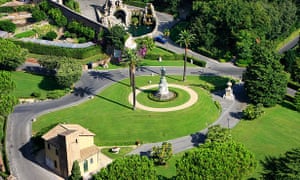
Aerial shot of the Vatican gardens from St Peter's Basilica, Rome.
 Aerial shot of the Vatican gardens from St Peter’s Basilica, Rome. Photograph: Alamy
The tour of the grounds, aboard a tiny land train, is revelatory. Formal gardens are interrupted by fields of alfalfa grazed by the cows that provide milk to the Vatican. Roman ruins – including a theatre built for the Emperor Domitian in the first century AD – jut out from behind fragrant trees.
Back in Albano Laziale, some exploration leads me to organic, vegetarian restaurant Le Bioalchimie (Via San Filippo Neri 16) for a €15 buffet lunch of local produce. The train back to Rome departs Albano Laziale at 5.18pm, depositing us at San Pietro, a station just outside the Vatican walls.
A stroll to St Peter’s Square, where high walls obscure the gardens and the Basilica hides the 60-metre Vatican hill, makes for a tantalising end to a fascinating day.
 Vatican by Train tours run on Saturdays only at 8am. Book online atbiglietteriamusei.vatican.va/musei/tickets/do
By Liz Dodd, www.theguardian.com


Tuesday, May 19, 2015

10 Of The Best European Islands … That You’ve Probably Never heard Of

Lyngør, Norway

The Lyngør islands, Norway. Photograph: Matti Bernitz


Explore Europe’s lesser-known islands and enjoy a leisurely break where walking, watersports and doing nothing at all are the order of the day


Lyngør Islands, Norway

A far cry from Norway’s jagged western fjord-filled coastline, the Lyngør Islands offer Baltic calm rather than wild Atlantic. Base yourself on the islands of Sandøya or Borøya (where you can park your car) and use the ferries to get around. If ferries are too mainstream, Norwegians rave about kayaking between these tiny islands, so expect to see lots of brightly coloured boats being hefted around by visitors. Kayak rental is available in Tvedestrand, the town at the head of the fjord. Lyngør Island can only be reached by boat: there are no cars, and the main village consists of weathered clapboard wooden houses.
Stay The Tvedestrand 58 holiday house on the island of Boroya, which sleeps up to six, costs from £455 for seven nights.
Getting there Norwegian airlines flies to Oslo from £40 return; it’s then a two-hour drive south.

Mljet, Croatia

Beach Stara Baska - island Krk, Croatia
Pinterest
 Photograph: Alamy
Odysseus was allegedly held captive here, for seven years, by the nymph Calypso, but it can’t really have been all that bad. One of Croatia’s southernmost islands, it’s best known for exceptional local produce and wild beauty. There are great hiking opportunities around the two saltwater lakes in Mljet national park and it is possible to hire a sailing boat to reach the 12th-century Benedictine monastery on Melita Island. Scramble around the island’s shady trails and swim in some of the clearest water in the Adriatic at Blace Bay. Choose a bottle of local red for your sundowner – Dingac and Postup are produced on the island – and try the plates of raw mussels drizzled with lemon juice, a local speciality.
Stay There’s only one hotel and it’s right on the coast – the three-star Odisej Mljet, with doubles from £33 B&B.
Getting there It’s a 90-minute ferry from Dubrovnik to the bay of Sobra on Mljet on Jadrolinjia lines.

Aegina, Greece

The hillside village of Vagia on Aegina, Greece
Pinterest
 The hillside village of Vagia on Aegina. Photograph: Alamy
Come for the seafood, stay for the peace. Aegina, only one hour by ferry from Athens, is a great base during a summer weekend break. The heat in the city can be harsh; escape the crowds to spend evenings snorkelling the coast and devouring cuttlefish in wine sauce at Nontas – a beachside taverna close enough to the water to see your dinner being caught by local fishermen. As for hiking, the island’s trails lead you past ruined churches, meadows of wildflowers, and craggy hillsides.
Stay Clean, bright, and sun-drenched rooms at the Marini Luxury Apartmentscome with balconies and panoramic views over the sea, doubles from £66.
Getting there Metro from Athens centre to Piraeus port, an hour’s hydrofoil journey (£7) to Aegina.

Fehmarn, Germany

Dike Path, Sulsdorfer Wiek with Sun, Summer, Orth, Baltic Island of Fehmarn, Germany
Pinterest
 Photograph: Alamy
Fehmarn, an island just off Germany’s Baltic coastline, catches the rays in spades while adventure junkies can kitesurf the days away (it plays host to various kite surfing competitions every year). Those after a more gentle ramble should pack their boots for Fehmarn’s portion of the Via Scandinavia: a walking route from LĂĽbeck that runs through Germany and Poland, and on to Norway. Fehmarn’s scenery makes it unique among Germany’s Baltic islands. Badwelt Fehmare is a spa complex on the island and many visitors make the journey to enjoy seaweed wraps (taken from the shore) and natural saltwater scrubs.
Stay Close to the old town and a sandy beach, Apartments mit Flair has accommodation from £42 a night.
Getting there From Hamburg it’s a 90-minute drive to Burg, the historical capital of Fehmarn.

Inis OĂ­rr, Aran Islands, Ireland

Inisheer (Inis Oirr), Aran Islands, Ireland.
 Photograph: Christophe Boisvieux/Corbis
This is an island of ancient language and mythology where the white beaches stretch out into the Atlantic. The smallest island in the Aran archipelago, Inis OĂ­rr (pronounced Inisheer) only got permanent electricity in 1997. The Inis OĂ­rr trail threads through fields carpeted with wildflowers; gentian, cranesbill and ladies mantle dust your ankles as you pace around the island under the shadow of O’Brien’s ruined 14th-century castle. Recuperate at Ostan Inis OĂ­rr with a pint of Guinness and live music, which gets visitors up for a dance.
Stay South Aran House, with doubles from £60 B&B, is a guesthouse with free Wi-Fi, four en suite rooms and underfloor heating. The attached cooking school suggests that guests are in for a treat at breakfast.
Getting there Ferry from Ros a’Mhil costs £19, adult return, with Aran Island Ferries.

Belle-ĂŽle en Mer, Brittany, France

Port Sauzon, Belle-ile-en-Mer, France
Pinterest
 Port Sauzon, Belle-ĂŽle-en-Mer. Photograph: J P De Manne/Getty Images
An island that lives up to its name, its dramatic coastline and green interior inspired 19th-century authors and artists, most famously Flaubert and Monet. Now it draws holidaymakers in their droves in August, but outside of this short peak season its 60 beaches are gloriously crowd-free; and even in August your fellow tourists are unlikely to be Brits, who prefer chichi ĂŽle de RĂ© further south over its wilder Atlantic cousin. While Belle-ĂŽle has a handful of low-key attractions, including Sarah Bernhardt’s house, now a museum, and the lighthouse at Bangor, the main draw is the natural environment. In August beach lovers and walkers are joined on the island by opera buffs who come for the popular classical music festival Lyrique en Mer. Read more on the island in our Brittany article.
Stay Hotel Le Clos Fleuri has doubles from £53.
Getting there Ferries leave from Qubieron, 14km away.

CĂ­es islands, Galicia, SpaiFrancen

Rodas beach on Las Islas CĂ­es
Pinterest
 Rodas beach on Las Islas CĂ­es. Photograph: Alamy
Despite this paper naming Rodas beach on Las Islas CĂ­es one of the best beaches in the world, these islands remain an off-the-beaten-track gem, thanks to a strict limit of 2,200 tourists a day. Their nickname – the Maldives or Seychelles of Spain – gives a clear indication of what to expect: gorgeous white beaches, turquoise waters … in other words, your average untouched paradise. The three islands (Monteagudo, San Martiño and Faro) opposite the town of Vigo on the Galician coast form part of the Islas Atlánticas national park. This means its wildlife, including colonies of marine birds and rich marine life – which can be explored by scuba divers (with a permit) – is protected.
Stay The only accommodation is a campsite – Camping de las Islas CĂ­es – with 800 places on Faro, which opens in Easter week, and on subsequent weekends until June, and then regularly between June and September. From £5 adults, £4 kids; £50 to hire a double tent.
Getting there A ferry service from the harbours of Vigo, Cangas and Baiona starts in Easter week and runs weekends and then everyday between the beginning of June and the end of September.

Hiiumaa, Estonia

Tahkuna Lighthouse on Hiiumaa.
Pinterest
 Tahkuna Lighthouse on Hiiumaa. Photograph: Alamy
The smell of nature hangs heavy on Hiiumaa: from white sand beaches slightly damp after a rainfall, and seaweed sweetly fermenting at one end of the beach. The second largest island in Estonia, this is the place to come if you have a book to write or pictures to paint. There’s not much to do other than tramp along the coastal paths and admire centuries-old Baltic-style lighthouses. For history buffs, there’s an old Soviet bunker to explore, but mostly people come here to feel the sand between their toes and clear their heads. Thanks to the island’s microclimate, Hiiumaa is a lot warmer than Estonia’s mainland, which makes exploring the town of Kardia’s wooden houses and relaxing in Roograhu harbour’s floating sauna even more appealing.
Stay Kassari Puhkekeskus, doubles from £50, has bicycles to rent and a large sauna.
Getting there It’s a 35-minute flight from Tallinn or half-hour ferry ride from RohukĂĽla, details for both at hiiumaa.ee

Samothrace, Greece

DDR639 Doric  Hieron  temple, Sanctuary of the Great Gods on Oros Fengari (Mount Moon), Samothrace island. Northern Aegean Sea, Greece
Pinterest
 Sanctuary of the Great Gods on Samothrace. Photograph: Alamy
The drums beat late into the night and oil torches flare at one of Samothrace’s many beach parties. Eyes closed, the smell of bonfires and tannic red wine transport you back to when life was dictated by the Temple of the Winged Nike, now a crumbling ruin. Its many repeat visitors love the unaffected nature of this north Aegean island. As well as a solid collection of hiking paths, a bucolic waterfall trail, and sweeping deserted beaches, the island’s hot springs and hillside thermal pools only add to the sense of otherworldliness.
Stay The Archondissa Boutique Beach Aparthotel is secluded and just 20 metres from the beach. Each room has a sizeable balcony and terrace, studios from £40.
Getting there A Saos ferry from Alexandroupoli (on the mainland) takes three hours. Thessaloniki is six hours including drive and ferry.

Margaret Island, Budapest, Hungary

Margaret Island in Budapest Hungary
Pinterest
 Photograph: Alamy
Margaret Island, in the middle of the Danube in central Budapest, spends winter shrouded in mist; come summer the island is an oasis in the midst the city. Encircled by a 5km asphalt running track and jetties from which to launch small boats (and bodies – some of the swimmers here are hardy folk), the illusion of an island holiday is enhanced by two thermal spa complexes. Both cost less than £10 for the day, and, after you’ve soaked, take a romantic walk around the island to visit the ruins of the 13th-century nunnery. At sunset grab an ice-cream and sit down to watch the fountains dance in time to the music.
Stay The Danubias Grand Hotel Margritsziget has doubles from £68.
Getting there The island is a five-minute walk across the bridge from Budapest’s district IV.
Contributed by Eleanor Ross, www.theguardian.com