Showing posts with label Vatican City. Show all posts

Tuesday, July 26, 2016

Meet Pope Francis At The Vatican: IfOnly and Killerspin to Offer Once-In-A-Lifetime Opportunity To Join His Holiness At World UnPlugNPlay Festival

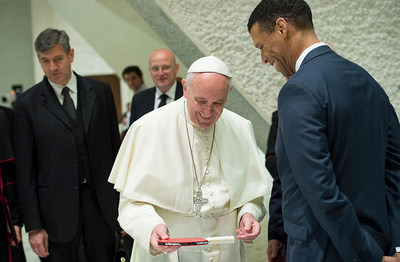
Pope Francis with Killerspin CEO Robert Blackwell Jr.
 Shaking hands and even snapping
 a photo with Pope Francis at the
 World UnPlugNPlay Festival in
 Vatican City might seem outside
 the realm of reality. However, this
 bucket list experience is actually
 available to anyone who purchases
 a once-in-a-lifetime package
 unveiled today on experiences
 marketplace IfOnly. 
Killerspin, the world's only luxury
 table tennis experience brand,
 has partnered with IfOnly, the
 leader in one-of-a-kind
 experiences that benefit charitable causes, to create an exclusive package offering the opportunity to
 meet Pope Francis at the Vatican as part of the World UnPlugNPlay Festival August 29-31st, a
 celebration to encourage people to play table tennis with loved ones and unplug from electronic
 devices for 15 minutes a day. 

In addition to a meeting with His Holiness, the IfOnly/Killerspin Package includes table tennis
 tournaments, several exclusive gatherings including the Connect21 Ping Pong cocktail reception,
 gala dinner and panel with thought leaders discussing "digitization and humanity." In addition, the 
excursion includes private VIP tours of the Vatican, Sistine Chapel and Palazzo Colonna, a two-night
 stay at a luxurious Sardinian resort and a host of limited edition memorabilia and products from Killerspin.

About World UnPlugNPlay Day
UnPlugNPlay Day on August 29, 2016 was created by Killerspin in partnership with the Italian Table
 Tennis Federation to encourage family and friends to put away their computers and mobile phones -
 unplug in order to have fun, and connect with those they love and who need their love. The event
 will launch in Vatican City attended by the Pope, along with a series of other grassroots events in
 major cities around the world.

According to Killerspin CEO Robert Blackwell Jr., the idea behind UnPlugNPlay grew out of a
 conversation he had with Pope Francis earlier this year about the growing alienation of humanity
 caused by an increasingly digitized society. As he explains, "The Pope and I spoke about how
 technology is changing the way we communicate, to the detriment of our relationships with
 others and our health. For at least this one day, we hope people will put away their devices in order to
 have fun, and connect with those they love."

IfOnly Vatican Package Details
Two packages are offered exclusively on IfOnly.com and start at $15,000. The "Vice-Chairman
 Package" for two includes a tour of the Sistine Chapel, tickets to the Connect21 Ping Pong 
Cocktail Reception and Gala Dinner, and panel discussion with thought leaders. The "Chairman"
 package can be purchased for one or two persons, starting at $25,000, and includes a meet
 and greet with Pope Francis, tickets to the Connect21 Ping Pong Cocktail Reception, Gala Dinner
 and panel discussion, a three-day, two-night stay at a world-class Sardinian resort where the
 UnPlugNPlay Table Tennis Championship will be held, as well as the Revolution SVR Bianco
 table, one of only 37 replicas of the Killerspin Table Tennis Table gifted to the Pope.
In keeping with Pope Francis' lifelong dedication to public welfare, this experience will benefit
 Best Buddies, a nonprofit dedicated to providing opportunities for people with intellectual
 and developmental disabilities.

About IfOnly
From unique everyday offerings with local experts to once-in-a-lifetime connections with
 lauded luminaries, IfOnly provides access to a curated selection of extraordinary experiences
 that benefit worthy causes around the world. IfOnly was founded in 2012 by serial entrepreneur
 Trevor Traina and is funded by Khosla Ventures, Founders Fund, AMEX Ventures, Triple Point
 Capital, and others.

Tuesday, November 24, 2015

Where To See The 5 Most Glamorous Locations In Spectre

Glamorous locations pepper the new James Bond movie, Spectre, like bullets from 007’s Walther PPK. But these breathtaking places aren’t guarded secrets and you don’t have to be licensed to kill to visit them. There’s no need to worry, either, that in travelling like Bond you will be plagued by evil villains – you will only find, upon reaching these destinations, scintillating scenery, grand architecture, atmospheric dining, and ready-made memories as vivid as anything on the big screen.
Mexico City, Mexico: Zócalo Square
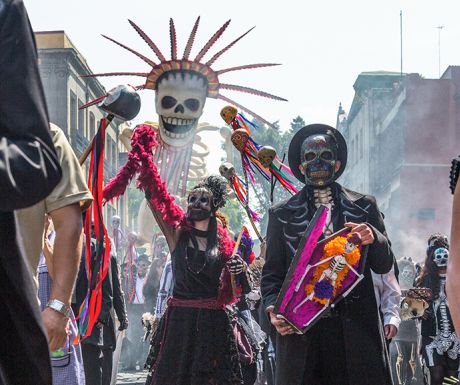
In the breathlessly dramatic opening sequence of Spectre, James Bond chases white-suited villain Marco Sciarra through central Mexico City, struggling to make his way through streets jammed with people dressed as the deceased. This ghoulish scene of skulls and skeletons, ominous with the ever-present threat of death, is a representation of the Dia de Muertos (Day of the Dead), an annual event which usually takes place in early November. The scene is filmed in the streets around the enormous Zócalo Square, where Sciarra attempts an airborne escape by helicopter.
Also known formally as Plaza de la Constitución, Zócalo Square has been a gathering place for Mexicans since Aztec times and lies at the heart of Mexico City’s Historic Centre. This UNESCO World Heritage site extends from the Square in all directions, seducing sightseers with museums, cafes, restaurants, the National Palace, the largest cathedral in the Americas, the remains of an Aztec temple, and more than 1500 other buildings of historical importance. Here, too, is the Gran Hotel Ciudad de México, another Spectrelocation, with its fabulously lavish Art Nouveau interior.
Zocalo Square in Spectre
Sölden, Austria: Ice Q
Ice Q, a modernist three-storey glass-and-steel restaurant perched on a snowy crag above the Austrian ski resort of Sölden, is likely to become Spectre’s iconic location. This building doubles in Spectre as a private medical clinic and the lair of Bond’s nemesis, Blofeld. At 3048 metres above sea level, it is reached by the cable car which features in one of the movie’s major action sequences.
From the stunning stone and oak dining room at Ice Q you look out through walls of sheer glass at the jagged white peaks of the Tyrolean Mountains. Sölden boasts three summits, each reaching above 3000 metres, with 90 miles of ski runs. Tucked into the Őtzal valley, 60 miles south-west of Innsbruck, the town has one five-star hotel, Das Central, where the Spectre stars stayed.
Ice Q, Solden, Austria
Tangier, Morocco: the medina
Bond’s mission takes him from the swirling snow of the Austrian Alps to the searing heat of North Africa. Accompanied by colleague Dr Madeleine Swann, he is seen hurrying through the tangled streets of a high-walled medina, before taking a train that heads into the desert.
The town is Tangiers, scandalous in the 1920s as the haunt of free-thinking artists and writers, and now at last being rescued by state investment from decades of decay. The Tangier Inn, recently renovated, was the shabby hangout of Beat generation writers such as Jack Kerouac, and the Grand Hotel Villa de France keeps a room frozen in time in honour of artist Henri Matisse, but it’s the El Minzah Hotel where Bond author Ian Fleming checked-in, in 1957, and where Blofeld actor Christoph Waltz chose to stay during the filming ofSpectre.
The train is the privately-run Oriental Desert Express, which will convey you in old-fashioned style on the 190-mile journey from Oujda near Morocco’s north-eastern border to the desert city of Bouarfa. During this 12-hour trip the locomotives halt several times for sightseeing and photo opportunities, punctuating the leisurely progress past the Sahara’s high dunes and encampments, scrubs and sands.
James Bond in Tangier
London, England: Rules restaurant
On a rainy night in London, Bond’s boss M pauses outside a restaurant to shake water from his umbrella before slipping through its door. At a table in the sumptuous interior, he joins MI6 colleagues Q and Miss Moneypenny. They have chosen to meet here, rather than at the office, to hide away from prying eyes – but you can find this place easily enough, at 34-35 Maiden Lane in Covent Garden. Its name, Rules, is proudly embossed in gold on two maroon canopies overhanging the big Georgian windows.
Established in 1798 and claimed to be the oldest restaurant in London, Rules has been frequented over the years by many notable artists, writers and actors, and appears in novels by, among others, Graham Greene, Evelyn Waugh, and John Le Carré. As you might expect, the food is of a high standard and traditionally British, the menu tempting with such delights as game, oysters, pies, and hearty puddings. What you might not expect, because of the restaurant’s central location and glamorous associations, are the prices, which won’t leave you shaken or stirred.
Rules restaurant, London
Rome, Italy: Vatican City
During a night-time car chase through the narrow alleyways, slippery cobbled streets, and grand squares of Rome, James Bond in his Aston Martin and henchman Mr Hinx in his Jaguar play a dangerous game of cat-and-mouse which comes to a spectacular end. At a less frenetic pace, and in daytime, there is much to be enjoyed by taking the same route on foot.
The Rome car chase hurries through the Piazza Navona, built on the site of a stadium where the ancient Romans watched games; speeds under the Passeto wall, which runs from San Pietro to Castel Sant’Angelo and was reserved, just in case, as an escape route for Popes; slides along the cobbled roads on the Via Panisperna in Rome’s cool Monti neighbourhood with its bohemian bars, fashion shops, and restaurants; blasts through St. Peter’s Square, overlooked by the world’s most famous example of Renaissance architecture, St. Peter’s Basilica; clatters down the wide steps of the Scalo De Pinedo to the edge of the River Tiber; then rushes perilously along the embankment pathway right beside the Tiber’s grasping waters. A hop-on, hop-off cruise along the Tiber is a calming way of reaching the Vatican City and the Colosseum while also taking a breather from the Eternal City’s hustle and bustle.
Vatican City, Rome

Saturday, October 17, 2015

10 Of The Best Ancient Ruins … That You’ve Probably Never Heard Of

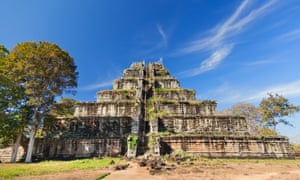
CE7J30 Ancient khmer pyramid in Koh Kher, Cambodia.
Ancient Khmer pyramid in Koh Kher, Cambodia. Photograph: Alamy


Done Pompeii, Ephesus and Angkor and still thirsting after archeological marvels? The founder of Timeless Travels magazine recommends 10 less well-known sites that can usually be savoured without the crowds


Koh Ker, Cambodia

Lost to forest and abandoned for over a thousand years, you’ll find this little-visited site in northern Cambodia. It’s less than two hours’ ride from its more famous cousin, Angkor Wat, and well worth a visit to see more than two dozen temples emerging from the jungle. A highlight is a seven-tiered pyramid, 40 metres high, which is thought to have been the state temple of Jayavarman IV and is often compared to Mayan temples. The site was the capital of the whole Khmer empire from 928-944AD.
 A new road means day trips to Koh Ker are possible from Siem Reap, but there are also now a few basic guesthouses and an ecolodge for those who want to stay longer

Choquequirao, Peru

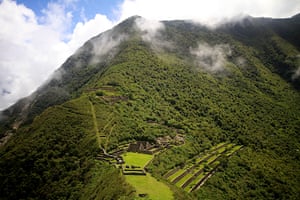
Choquequirao is a ruined Inca city in south Peru
Pinterest
 Photograph: Zachary Bennett/Corbis
Little sister to the better-known Machu Picchu, Choquequirao is one of the most-rewarding travel destinations in the Americas. Only a few hundred people visit during the dry season (May to October), compared with thousands each day at Machu Picchu. At 3,000m, the site sits on a cloud-forest ridge, 61 miles west of Cusco in the remote Vilcabamba range. The city was built by Topa Yupanqui, son of the man who built Machu Picchu, Pachacuti, some time in the 15th century. It’s a two-day trek to Choquequirao from the town of Cachora (though a cable car link is planned), and exploring it and the outlying sites of Capullyoc, Hurincancha and Casa de Cascada with a guide will take several days.
 Buses run from Cusco to Ramal, close to Cachora, where guides and pack mules can easily be hired

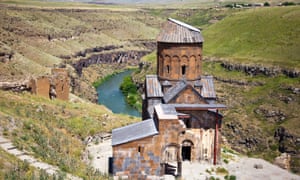
The ruined church of Saint Gregory in Ani, Turkey.Ani, Turkey

Pinterest
 The ruined church of Saint Gregory in Ani. Photograph: Alamy
There are some wonderful treasures in the far east of Turkey and one of them is the site of Ani. Capital of the Armenian Bagratid dynasty until the 11th century, and situated on key trade routes, it flourished for over 400 years and at its peak was larger than any contemporary European city, with a population of over 100,000. It was destroyed by an earthquake in 1319, and today its ruins are spread over a wide area, with the remains of spectacular churches, a Zoroastrian fire temple, palaces and city walls. Take a picnic and spend a day exploring the site.
 Ani can be reached by taxi or hire car from the town of Kars, 46km away and served by internal flights from Ankara or Istanbul

Conimbriga, Portugal

Roman ruins (House of fountains), Conimbriga
Pinterest
 Photograph: Getty Images
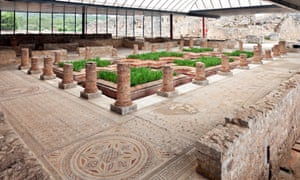
This is one of the largest Roman settlements in Portugal – roughly halfway between Lisbon and Porto, near the village of Condeixa-a-Nova. It was a prosperous town in Roman times and, while not the largest Roman city in Portugal, it is the best preserved. Although only a small section of the site has been excavated, there are baths, luxurious houses, an amphitheatre, a forum, shops, gardens with working fountains and city walls to explore, with many wonderful mosaics still in situ. In its centre is one of the largest houses discovered in the western Roman empire, the Casa de Cantaber, which is built around ornamental pools in superb colonnaded gardens and has its own bath complex and heating system. There is also a good museum, cafe and picnic site. Pick up a guidebook from the museum and have a few euro coins in your pocket to make the fountains work.
 Easyjet and Ryanair fly to Porto and Lisbon from about £50 return

Han Yangling, China

Terracotta figures at Han Yang Ling Museum.
Pinterest
 Terracotta figures in the Han Yangling museum. Photograph: Alamy
A smaller version of the Xi’an terracotta warriors, this often-overlooked site is the the tomb of E mperor Jing Di , who died in 141BC, and his Empress Wang. The site, 20km north of Xi’an, is well laid-out, with glass panels over the burial pits so you can see everything in situ, and there is also an excellent museum. The warrior figures here have individual faces; their arms were made of wood and they wore clothes. Sadly, both have disintegrated now, though examples can be seen in the museum. The pits are filled with figurines of courtiers and animals, and you can see the fossilised remains of wooden chariots.
 Han Yangling is easily reached by taxi, from Xi’an international airport (25 minutes)

Pella, Jordan

Ruins in Pella, Jordan
Pinterest
 Photograph: Corbis
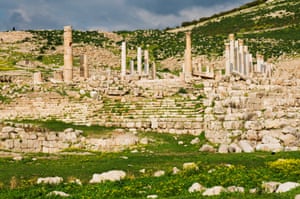
Frequently bypassed for the larger sites of Jerash and Umm Qais , Pella, in the north Jordan valley, is a multi-period site, occupied since neolithic times. It has some stunning Roman/Byzantine remains, and recent excavations have unearthed a Canaanite temple dating from 1700BC and early-bronze-age city walls dating from 3200BC. Take the time to climb to the top of Tell Husn, the southern mound overlooking the dig house, and you will be rewarded with a fantastic view across the excavations and the Jordan valley.
 The site is 45 minutes by road from the city of Irbid (two hours from Amman). Buses run from Irbid to the present-day village of Tabaqat Fahl

Vatican Necropolis, Italy

Roman necropolis in the Vatican.
Pinterest
 Photograph: AGF/Rex
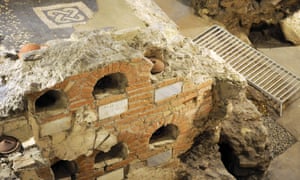
Beneath the Vatican City lie the ancient streets of Rome and an ancient burial ground, the Vatican necropolis – originally a cemetery on the southern slope of Vatican Hill. Saint Peter is said to be buried here, after he was martyred in the nearby Circus of Nero. Emperor Constantine I built a basilica above the apostle’s grave in the fourth century AD, and excavations in the 1940s did find a number of mausoleums. To walk at ancient street levels through the necropolis is an exciting experience for those who love to step back in time.
 Visits must be booked with the Vatican Excavations Office. Tours, in groups of about 12, last 90 minutes

Takht-e Soleyman, Iran

Takht Soleyman
Pinterest
 Photograph: /Getty Images
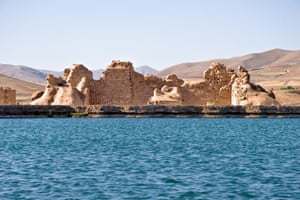
Takht-e Soleyman, meaning Throne of Solomon, is a breathtaking site built around a mineral-rich crater lake 30km north of Takab in Iran’s West Azerbaijan province. The earliest remains date from the Sasanian period, from 224 to 651AD. Set in a vast, empty landscape 2,000 metres above sea level, the site includes the remains of a Zoroastrian fire temple complex and a 13th-century Mongol palace. It is surrounded by an oval wall with 34 towers and two gates. The lake is 60 metres deep and so filled with minerals that it contains no life and is undrinkable. Don’t miss the small museum, housed in an Ilkhanid (a 13th-century building), with fine examples of tile, ceramics and stucco decoration. 
 The site is about two hours by taxi from the city of Zanjan, which is served by buses and trains from Tehran

Fatehpur Sikri, India

Fatehpur Sikri, India
Pinterest
 Photograph: /Corbis
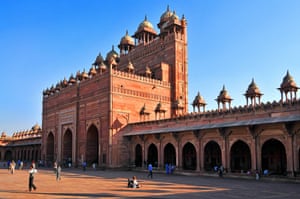
This surprisingly intact walled and fortified Mughal city is 40km west of Agra and the Taj Mahal in Uttar Pradesh. Built by Emperor Akbar in 1571, it was the Mughal capital for 14 years before being abandoned for lack of water. A stunning royal complex of pavilions and palaces include a harem, a mosque, private quarters, gardens, ornamental pools, courtyards and intricate carvings. It is the best-preserved collection of Mughal architecture in India. Don’t miss the Rumi Sultana palace, the smallest but most-elegant structure in the complex, and the secret stone safes in the corner of the Treasury, which also houses a museum opened just last year.
 The complex is an easy day trip from Agra: take a bus or train to Fatehpur station, 1km from the site

Pula, Croatia

Ancient Amphitheater Pula, Croatia
Pinterest
 Photograph: Getty Images
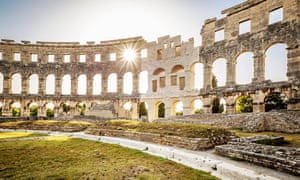
The amphitheatre of Pula is the only Roman amphitheatre to have four side towers and all three levels preserved. Built between in 27BC and 68AD, it is one of the six largest surviving Roman arenas in the world, and the best-preserved ancient monument in Croatia. Overlooking the harbour in the north-east of the town, it seated 20,000 spectators. In summer there are weekly re-enactments of gladiator fights, and it is also used for plays, concerts and the September Outlook festival. Look out for the slabs that used to secure the fabric canopies that sheltered spectators from the sun.
 Ryanair flies to Pula from Stansted from £117 return
by Fiona Richards