New search data reveals how airfare is evolving across domestic and international travel.
KAYAK has launched a new Airfare Trends Dashboard, offering a weekly view of how flight prices are changing over time using KAYAK search data. With week-over-week and year-over-year insights across domestic and international destinations, the tool gives travelers a clear look at how factors like seasonality, fuel costs, and broader macro trends are shaping airfare, so travelers can plan and book with confidence.
The dashboard includes:
Weekly airfare trends: A comprehensive view of how average flight prices domestically and internationally are changing from week to week, updated every Tuesday
Year-over-year context: Comparisons to 2025 to help contextualize current pricing levels and how they compare to the same time last year
Destination-level data: A city-level view at how airfare varies across some of KAYAK’s popular domestic and international destinations and how each is evolving over time
The data tracks airfare trends starting from the first full week of January in 2026 and 2025, offering a clear view of both short-term fluctuations and longer-term patterns.
What KAYAK is Seeing
Domestic airfares are trending upward - but steadily. Prices have risen since January, with consistent week over week increases and no major volatility.
International airfare trends mimic 2025. Prices this year are moving in line with last year’s week-over-week patterns, pointing to familiar seasonal shifts in demand.
“Airfare trends are evolving differently across routes - while some are getting more expensive, others are seeing prices decline,” said Kayla DeLoache, KAYAK Travel Trends Expert. “For example, flights to destinations like Hilo, Hawaii, Palermo, Italy, and Georgetown, Cayman Islands are down as much as 18%. Looking at how prices are changing week to week can help travelers make more informed decisions about when and where to travel.”
KAYAK’s Tips to Save Money
As airfare trends continue to shift, travelers may be weighing different ways to get to their destination. KAYAK has updated its Trip Calculator with the latest gas prices and airfare data to help compare the cost of flying versus driving. Simply enter your route, travel month, and number of travelers to evaluate options. While rental car searches are rising, prices remain relatively stable, increasing between $2 and $5 compared to last month.
Beyond comparing travel modes, KAYAK also offers tools to help travelers find and secure the best prices:
Flexible Dates tool: Compare different departure and return days for flights and hotels to find cheaper options (e.g., midweek vs. weekend travel)
Price Alerts: Track fare changes across flights, hotels and rental cars and book when prices drop
Explore tool: Discover flight destinations that fit your budget
Layover filter: Exclude specific airports to customize itineraries, including routes through the Middle East
Showing posts with label Airfare tips. Show all posts
Tuesday, April 21, 2026
Wednesday, November 15, 2023
$29 Flights Are Back As Airlines Race To Fill Seats In The Off-Season
Airlines have a record 260 million seats to fill this quarter, and to do it, they’re offering fares that will run you about the same as a pair of movie tickets.
Southwest Airlines, for example, last month offered one-way fares of $29 for flights early in the morning or at night, just one example of airline discounting for off-peak periods.
“I would characterize the amount of discounting or sales that we’re doing today as a bit more than normal,” Ryan Green, Southwest’s chief commercial officer, told reporters at the Skift Aviation Forum earlier this month. He said the industry’s increased capacity in recent months means there are more seats to fill, even though the carrier’s average fare was up in the last quarter from a year ago.
Leisure travelers, meanwhile, have largely returned to more traditional booking patterns after years of pandemic swings in demand, leaving airlines looking for ways to fill planes outside of holidays or other popular travel periods.
“Typically, you see a step increase in price at each seven-day mark before a flight,” said Scott Keyes, founder of Scott’s Cheap Flights, a flight-deal company that recently rebranded as Going. But airlines are either dropping last-minute fares or not raising them as much as usual, he said.
Airlines have scheduled a record 259.8 million seats for domestic flights in the fourth quarter, up nearly 8% from last year, on 1.86 million flights, up 6% from 2022, according to aviation-data firm Cirium.
Getting the balance right in the off-season is a challenge for airlines, which make the majority of their revenue in the second and third quarters during the busy spring and summer seasons. Most major carriers reported record revenue and strong demand during those periods, with some executives reporting higher growth for international destinations over domestic ones.
Falling fares
The U.S. inflation read for September showed airfare dropped more than 13% from a year earlier, while overall consumer prices rose.
JetBlue Airways said average fares dropped more than 12% in the third quarter during the same period of 2022 to $201.73.
Budget carrier Spirit Airlines said fares dropped nearly 28% from a year earlier to $48.73, though non-ticket revenue, which includes add-ons such as seat selection fees and checked bags, rose 1% to $67.70.
The Miramar, Florida-based airline, which JetBlue is trying to buy, warned about fare discounting before Thanksgiving and said, “unfortunately, we have not seen the anticipated return to a normal demand and pricing environment for the peak holiday periods.”
Fellow ultra-discounter Frontier Airlines said fares averaged a little more than $39 in the last quarter, down 32% from a year ago.
All three carriers forecast losses for the last three months of the year.
Rethinking capacity
Declining pricing power in the off-peak periods has forced carriers to rethink where they’re deploying their planes.
Southwest plans to slow its growth next year to address the shifting demand patterns, though CEO Bob Jordan described demand on an earnings call late last month as “strong.”
“Capacity is the most precious commodity you have to produce revenue, and you got to deploy that capacity as efficiently as possible against demand,” Jordan said during the Skift Aviation Forum.
The carrier is planning to fly less on nonpeak days, like Tuesdays, compared with higher-demand periods, a measure that also prioritizes crews’ time so they are ready fly more when it’s busy, Jordan said.
Frontier Airlines CEO Barry Biffle told CNBC that one thing the airline is changing is finding less crowded markets for its flights.
“We are concentrating our growth away from the saturated markets,” he said. “We will not shrink in Orlando and Vegas, but we’re probably not going to grow it either.”
Holiday demand is still strong
With shifting demand comes those eye-catching, double-digit fares.
But they’re usually gone quickly and are nearly guaranteed to be unavailable for peak holiday periods, with demand expected to hit or break records.
Delta Air Lines said it expects to carry between 6.2 million and 6.4 million passengers from Nov. 17 to Nov. 28 during the Thanksgiving period, compared with 5.7 million last year and 6.25 million in 2019. United Airlines said it expects to fly 5.9 million passengers from Nov. 17 to Nov. 29, up 13% from last year and 5% more than 2019. American Airlines forecast a record 7.8 million travelers from Nov. 16 to Nov. 28, up from 7 million last year and beating out 2019 by around 200,000 customers.
Southwest CEO Jordan said year-end holiday bookings are running ahead of last year’s pace.
Flight tracker Hopper said “good deal” domestic fares, which it defines as the bottom 10th percentile of available fares, are averaging $248 for Thanksgiving, down from $271 last year and $276 in 2019.
Could it last?
Airlines are now poring over their schedules for 2024 to try to best use their aircraft while they face higher costs such as fuel and labor that have pinched margins.
“You’re seeing carriers put out fares that look kind of like our fares, and what you should really think about is that that’s not going to be permanent,” Frontier’s CEO Biffle said, citing costs.
Carriers have gotten more sophisticated about addressing shifting demand patterns, meaning they can cut flights or capacity during travel lulls.
Next year, fares are likely to stabilize, but it’s too early to tell what promotional fares will be, said Henry Harteveldt, founder of travel industry consulting firm Atmosphere Research Group.
Frontier Airlines CEO Barry Biffle told CNBC that one thing the airline is changing is finding less crowded markets for its flights.
“If inflation really continues at the torrid place it has been, if we see hiring soften, airlines may feel a need to invest in deeper promotion,” he said.
One advantage for full-service carriers is the variety of fares and products they can offer, from no-frills basic economy to first class, Harteveldt. That means they could increase their inventory of cheaper basic economy fares during weaker demand periods, or raise fares when demand is high for premium seats.
Airlines “have the most sophisticated cash registers of any industry,” he said.
Source: Leslie Josephs, https://www.cnbc.com/
Southwest Airlines, for example, last month offered one-way fares of $29 for flights early in the morning or at night, just one example of airline discounting for off-peak periods.
“I would characterize the amount of discounting or sales that we’re doing today as a bit more than normal,” Ryan Green, Southwest’s chief commercial officer, told reporters at the Skift Aviation Forum earlier this month. He said the industry’s increased capacity in recent months means there are more seats to fill, even though the carrier’s average fare was up in the last quarter from a year ago.
Leisure travelers, meanwhile, have largely returned to more traditional booking patterns after years of pandemic swings in demand, leaving airlines looking for ways to fill planes outside of holidays or other popular travel periods.
“Typically, you see a step increase in price at each seven-day mark before a flight,” said Scott Keyes, founder of Scott’s Cheap Flights, a flight-deal company that recently rebranded as Going. But airlines are either dropping last-minute fares or not raising them as much as usual, he said.
Airlines have scheduled a record 259.8 million seats for domestic flights in the fourth quarter, up nearly 8% from last year, on 1.86 million flights, up 6% from 2022, according to aviation-data firm Cirium.
Getting the balance right in the off-season is a challenge for airlines, which make the majority of their revenue in the second and third quarters during the busy spring and summer seasons. Most major carriers reported record revenue and strong demand during those periods, with some executives reporting higher growth for international destinations over domestic ones.
Falling fares
The U.S. inflation read for September showed airfare dropped more than 13% from a year earlier, while overall consumer prices rose.
JetBlue Airways said average fares dropped more than 12% in the third quarter during the same period of 2022 to $201.73.
Budget carrier Spirit Airlines said fares dropped nearly 28% from a year earlier to $48.73, though non-ticket revenue, which includes add-ons such as seat selection fees and checked bags, rose 1% to $67.70.
The Miramar, Florida-based airline, which JetBlue is trying to buy, warned about fare discounting before Thanksgiving and said, “unfortunately, we have not seen the anticipated return to a normal demand and pricing environment for the peak holiday periods.”
Fellow ultra-discounter Frontier Airlines said fares averaged a little more than $39 in the last quarter, down 32% from a year ago.
All three carriers forecast losses for the last three months of the year.
Rethinking capacity
Declining pricing power in the off-peak periods has forced carriers to rethink where they’re deploying their planes.
Southwest plans to slow its growth next year to address the shifting demand patterns, though CEO Bob Jordan described demand on an earnings call late last month as “strong.”
“Capacity is the most precious commodity you have to produce revenue, and you got to deploy that capacity as efficiently as possible against demand,” Jordan said during the Skift Aviation Forum.
The carrier is planning to fly less on nonpeak days, like Tuesdays, compared with higher-demand periods, a measure that also prioritizes crews’ time so they are ready fly more when it’s busy, Jordan said.
Frontier Airlines CEO Barry Biffle told CNBC that one thing the airline is changing is finding less crowded markets for its flights.
“We are concentrating our growth away from the saturated markets,” he said. “We will not shrink in Orlando and Vegas, but we’re probably not going to grow it either.”
Holiday demand is still strong
With shifting demand comes those eye-catching, double-digit fares.
But they’re usually gone quickly and are nearly guaranteed to be unavailable for peak holiday periods, with demand expected to hit or break records.
Delta Air Lines said it expects to carry between 6.2 million and 6.4 million passengers from Nov. 17 to Nov. 28 during the Thanksgiving period, compared with 5.7 million last year and 6.25 million in 2019. United Airlines said it expects to fly 5.9 million passengers from Nov. 17 to Nov. 29, up 13% from last year and 5% more than 2019. American Airlines forecast a record 7.8 million travelers from Nov. 16 to Nov. 28, up from 7 million last year and beating out 2019 by around 200,000 customers.
Southwest CEO Jordan said year-end holiday bookings are running ahead of last year’s pace.
Flight tracker Hopper said “good deal” domestic fares, which it defines as the bottom 10th percentile of available fares, are averaging $248 for Thanksgiving, down from $271 last year and $276 in 2019.
Could it last?
Airlines are now poring over their schedules for 2024 to try to best use their aircraft while they face higher costs such as fuel and labor that have pinched margins.
“You’re seeing carriers put out fares that look kind of like our fares, and what you should really think about is that that’s not going to be permanent,” Frontier’s CEO Biffle said, citing costs.
Carriers have gotten more sophisticated about addressing shifting demand patterns, meaning they can cut flights or capacity during travel lulls.
Next year, fares are likely to stabilize, but it’s too early to tell what promotional fares will be, said Henry Harteveldt, founder of travel industry consulting firm Atmosphere Research Group.
Frontier Airlines CEO Barry Biffle told CNBC that one thing the airline is changing is finding less crowded markets for its flights.
“If inflation really continues at the torrid place it has been, if we see hiring soften, airlines may feel a need to invest in deeper promotion,” he said.
One advantage for full-service carriers is the variety of fares and products they can offer, from no-frills basic economy to first class, Harteveldt. That means they could increase their inventory of cheaper basic economy fares during weaker demand periods, or raise fares when demand is high for premium seats.
Airlines “have the most sophisticated cash registers of any industry,” he said.
Source: Leslie Josephs, https://www.cnbc.com/
Wednesday, April 5, 2023
Travelore Tips: New Google Flights Feature Guarantees The Lowest Price, Pays You Back If It’s Wrong
A new Google Flights feature tells you when to go ahead and book that flight, because it won't get any cheaper.
Google announced new travel features on Monday, including a price guarantee badge for booking flights. The badge, which has launched as a pilot program in the U.S., "means we’re confident that the price you see today won’t get any lower before takeoff," said VP of Travel Products Richard Holden in the blog post. If you see the "Price Guarantee" badge on a flight, that means the cost is likely the lowest it will go, so you can confidently book the flight without worrying it will get cheaper later. When you book, Google will keep monitoring the price and pay you back the difference through Google Pay.
Google Flights harnesses Google's search engine to find the best deals. With the new Price Guarantee feature, it takes that a step further by claiming to reliably predict when the price of a flight might go up or down.
With summer around the corner, it's suddenly time to start thinking about travel plans. Price Guarantee might take some of the guesswork out of the planning, so you won't have to worry about overpaying for a flight.
Now for the fine print. The feature is only available for airlines that use "Book on Google." That means you're most likely to see deals for Alaska, Spirit, and Hawaiian airlines, a spokesperson said.
The feature is currently only available for flights departing from the U.S. The price difference must be greater than five dollars, and the maximum amount of money you can receive is 500 bucks per year for a maximum of three bookings using Price Guarantee. In order to get money back, you must download the Google Pay app. Travelers will receive updates via email and Google Pay app notifications.
If all that sounds good to you, book away with the most powerful search engine on your side.
Source: https://mashable.com/
Google announced new travel features on Monday, including a price guarantee badge for booking flights. The badge, which has launched as a pilot program in the U.S., "means we’re confident that the price you see today won’t get any lower before takeoff," said VP of Travel Products Richard Holden in the blog post. If you see the "Price Guarantee" badge on a flight, that means the cost is likely the lowest it will go, so you can confidently book the flight without worrying it will get cheaper later. When you book, Google will keep monitoring the price and pay you back the difference through Google Pay.
Google Flights harnesses Google's search engine to find the best deals. With the new Price Guarantee feature, it takes that a step further by claiming to reliably predict when the price of a flight might go up or down.
With summer around the corner, it's suddenly time to start thinking about travel plans. Price Guarantee might take some of the guesswork out of the planning, so you won't have to worry about overpaying for a flight.
Now for the fine print. The feature is only available for airlines that use "Book on Google." That means you're most likely to see deals for Alaska, Spirit, and Hawaiian airlines, a spokesperson said.
The feature is currently only available for flights departing from the U.S. The price difference must be greater than five dollars, and the maximum amount of money you can receive is 500 bucks per year for a maximum of three bookings using Price Guarantee. In order to get money back, you must download the Google Pay app. Travelers will receive updates via email and Google Pay app notifications.
If all that sounds good to you, book away with the most powerful search engine on your side.
Source: https://mashable.com/
Tuesday, February 19, 2019
Hidden City Ticketing: The Travel Hack Airlines Don't Want You To Use

Katia Hetter and Jeff Simon, CNN
(CNN) — Nobody who sold you that instant oatmeal, jar of multivitamins, bar of soap, perfume-free laundry detergent, latest best-seller, NASCAR tickets or whatever Gwyneth Paltrow sells on her website will come after you to make sure you used your purchases.
But the world's biggest airlines might.
They require that you fly all the flights you've booked or pay the price. They might take away your frequent flier miles, ban you from the airline or even sue you.
"So, if I don't eat all my steak at Peter Luger's, are they going to sue me now?" Delta Air Lines frequent flier Billy Stocklin says. "It's my ticket and seat. I bought it. If I use it or not is none of your business."
The airlines beg to differ.
What is hidden city ticketing?
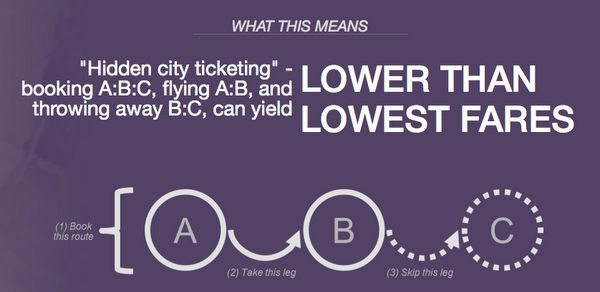
"Hidden city ticketing" is a longtime, under-the-radar practice of the most astute, rule-breaking fliers. It's now taking center stage in a lawsuit filed by Lufthansa, one of the world's largest airlines.
Lufthansa is suing a passenger who skipped out on the last leg of his ticketed purchase, demanding the money he would have paid for his actual journey. (The case was dismissed, but the airline has appealed.)
It can get complicated. Let's say you need to fly from New York City to Los Angeles, and the cheapest ticket you can find is selling for $500. There's another flight from New York to Reno, Nevada -- with a layover in Los Angeles -- that only costs $350.
If you get off the plane in Los Angeles -- throwing away the second flight from Los Angeles to Reno -- you'll get to La La Land at a "discount."
Airlines generally prohibit it in the fine print most passengers don't read, because they'd rather you pay $500 than $350 for your flight.
Hidden city ticketing may have remained hidden but for a 20-something named Aktarer Zaman. Zaman launched Skiplagged, a website designed to take advantage of the complicated ways airlines price their tickets.
United Airlines promptly sued him, but the case was dismissed in 2015, and the site is still operational.
Airlines charge more when they can
It's an issue because of the way airlines price their flights, says aviation expert Benét J. Wilson, owner and editor of Aviation Queen.
"Fares tend to be higher in general for more popular cities or ones where airlines don't have a lot of competition," she says. "For example, fortress hubs such as Frankfurt for Lufthansa, Atlanta for Delta, Dallas/Fort Worth for American and Newark for United fares have higher fares because more passengers fly through them to get where they need to go."
"Flights that don't have as many passengers are priced lower, and flights where the airline is just relocating the plane and trying to make some money to offset the costs will typically be priced lower," says Jeffrey C. Price, owner of Leading Edge Strategies and an aviation professor at Metropolitan State University Denver.
"Cities where there isn't a high demand can actually be priced higher due to the limited amount of flights in and out," says Price. "When there's only one or two flights a day out of some of these small airports, the airlines will charge what the market will bear."
It's not about the specific fare
Lufthansa, which made $41.5 billion last fiscal year, is suing the unnamed passenger for $2,392 for using the technique. While he's fighting back, others may not be able to finance a defense against a major airline.
Lufthansa spokesman Tal Muscal declined to comment, citing ongoing litigation.
The airline alleges that their customer booked a roundtrip from Oslo to Seattle with a layover in Frankfurt. On the return trip, the customer got off in Frankfurt, didn't fly to Oslo and instead booked a separate Lufthansa flight from Frankfurt to Berlin. (He did show his hand by booking the second flight on the same airline as his first flight.)
It's against the airline's contract of carriage (PDF), which is often hard to find on an airline's website.
"If carriage is not used on all individual legs or not used in the sequence anticipated on the ticket with otherwise unchanged travel data, we will recalculate the fare according to your altered routing," reads the Lufthansa contract.
"The fare will thereby be determined which you would have had to pay for your actual routing in your price group on the day of your reservation. This fare may be higher or lower than the fare you originally paid."
There is a price to pay
Even if the airline loses on appeal, it's sending a message to fliers willing to game the system that there may be a cost.
At the same time, the suit highlights how airlines can charge customers more to fly less.
"It's easy to understand why some travelers are tempted to risk it, especially if you live in a city where you don't have a lot of airline choices," Wilson says.
But she warns that you could be penalized if you're caught. "That can range from forcing you to pay the full fare you tried to avoid or even taking away your frequent flier miles."
Tuesday, December 26, 2017
Travelore Tips: How To Get Your Share Of $413 million In US Flight Delays Compensation In 2017
AirHelp, the number one flight delays compensation company, has revealed that over 584,000 US passengers have been affected by flight cancellations and severe delays of three hours or more. AirHelp has calculated that the passengers are eligible to claim over $413,000,000 in compensation in 2017.
The busiest travel month in the United States in 2017 was July, unsurprisingly falling on a busy month for tourism. Based on the percentage of disrupted international flights departing from airports around the United States, Leonardo da Vinci - Fiumicino Airport in Rome, Italy experienced the highest volume of flight disruptions, with London City Airport following closely behind.
As the 2017 AirHelp Score unveiled earlier this year, airports in the United States are considered as some of the worst in the world with Newark Liberty International Airport (EWR) and Los Angeles International Airport (LAX) falling into the worst global airports for their quality and service and the number of delayed flights throughout the period.
Henrik Zillmer, CEO of AirHelp comments: "2017 has been an interesting year for air passenger travel, particularly in the US with overbooked flights and cancellations making national headlines month after month. The consistent mistreatment of U.S. consumers paired with the recent decision by the Department of Transportation to scrap a proposal mandating airlines to be transparent about their fees, means it is more important than ever for consumers to fight for their air passenger rights.
"In the event of a delayed or cancelled flight, passengers may be legally entitled to receive up to $700 in compensation fees from airlines. However, despite this less than 2% of travelers will file for this compensation, not knowing that they are eligible.
"We urge passengers who may have been affected by delays or cancellations this year to read up on their rights to ensure that they're not missing out on the compensation that they're legally entitled to. At AirHelp, our mission is to help passengers get the compensation that they rightfully deserve."
For more information, visit: https://www.airhelp.com/en/
Air passengers who have experienced a delayed or cancelled flight can check their eligibility for compensation on the go, and make a claim in a matter of minutes through the free AirHelp mobile app, available for iOS and Android.
About AirHelp
AirHelp is the world's leading flight delays compensation company, helping passengers apply for compensation following a delayed, cancelled or overbooked flight. Since the business was founded in 2013, AirHelp has helped more than five million travelers process airline compensation claims worth more than £300 million in total reimbursement. AirHelp has offices in five cities across Europe, Asia and North America and is available in 30 countries, offering support in 16 languages. The business employs more than 500 employees worldwide.
AirHelp methodology:
AirHelp has the most reliable and most accurate collection of flight data in the world due to their consumption of so many data sources. Their database aggregates multiple data points from a variety of reliable sources such as government agencies, airport databanks, flight-tracking vendors, historical resources and commercial data brokers.
AirHelp are therefore able to maintain an accurate, real-time picture of flight disruptions occurring across the globe, the circumstances around these disruptions and the likelihood of further disruptions occurring.
Wednesday, April 19, 2017
Summer 2017 Travel: 10 Places To Go Where The Airfare Is Low From Cheapflights.Com, As Low As 40% Less Than Last Year
Start Planning Your Summer Getaway with These 10 Places to Where the Airfare is Low
If you put off that big summer vacation last year, this year might be the time to pick up and go. The travel experts at Cheapflights.com, the leader in finding and publishing online travel deals, have found that even after last summer’s seemingly record-low airfares, average flight prices to over half of the most popular destinations are shaping up to be more affordable this summer. A year-over-year comparison reveals a number of great getaways with notable (as much as 41 percent) discounts over last year’s average flight prices.
Pulling from this research, the Cheapflights.com team has made its picks for 10 places to go where the airfare is low with a line-up of destinations near and far to help you shape your summer travel plans. Check out these destinations that top the list and start packing:
· Barcelona, Spain, down 41% over last summer – Admiring Pablo Picasso’s art at the Museu Picasso, strolling Las Ramblas, walking through Gaudi’s Parc Guell and sampling Spanish wines and savory tapas are perennially popular pastimes in Barcelona. Thanks to the newly opened L9 metro line, visitors can now quickly and cheaply travel from Barcelona Airport to the city. Barcelona offers many new attractions this year, including the newly opened Ferrari Land and the opening of Sant Pau’s newly restored Sant Salvador hall. Barcelona is also hosting the 10th annual Circuit Festival, the largest LGBTQA festival in the world.
· Venice, Italy, down 31% over last summer – A trip to Venice, Italy, is always a priceless experience. Adding inexpensive airfare only sweetens the deal. There's plenty to do in the summertime, including experiencing the new Viva Vivaldi multimedia show at the Museo Diocesano d'Arte Sacra, which pays homage to Venetian composer Antonio Vivaldi. Venice’s social summer calendar is also filled with notable events like the Festa di San Marco, a water parade of traditional row boats; La Biennale, the (mostly) free art biennial event that features hundreds of international artists; and the Venice Film Festival in the Lido.
· Lisbon, Portugal, down 26% over last summer – Step back in time in Lisbon, Portugal. The coastal capital city is the picture-perfect place for summertime strolls past ornate, colonial architecture, historic sites like St. George’s Castle and Instagram-worthy views. Take a break from walking and hop on Tram 28 through the hilly Alfama neighborhood and get lost in the narrow, cobblestone streets flanked by cafes and shops.
· Knoxville, Tennessee, down 17% over last summer – Knoxville, Tenn., has a rich 225-year-old history that has beckoned travelers for decades. Music lovers will appreciate this summer's cheap airfare, as well as diverse musical offerings, including free live music six days a week at the Downtown Visitors Center and A-list country and rock ‘n’ roll concerts. A free trolley whisks travelers around downtown where visitors can learn more about the Civil War sites in the area.
· Dublin, Ireland, down 16% over last summer – The U.S. now has 20 airports offering direct flights to Ireland, making access easy and increasing the chances of scoring cheap airfare. You don’t need the luck of the Irish to discover Dublin on a budget either. We’ve found plenty of cheap (and many free) things to do in the capital of the Emerald Isle, like shopping local at the popular Ha’Penny Vintage and Craft Market, listening to local musicians for free at Whelan’s and people watching on Grafton Street. Summertime is also prime time to visit Dublin. Special events this summer include Bloomsday in celebration of James Joyce, Taste of Dublin and the Dublin Writers Festival.
Five equally awesome destinations (also with lower average airfares this summer) include: Colorado Springs, Colorado; Charleston, South Carolina; Hilo, Hawaii; Guatemala City, Guatemala, and Spokane, Washington. For more details and Cheapflights.com’s complete list of 10 places to go where the airfare is low, head to www.cheapflights.com/news/summer-airfare-deals.
Sunday, March 12, 2017
What Are The Best Airplane Life Hacks?
Jonathan Breeze, CEO at AardvarkCompare.com (2015-present)
The best, simplest, hack is to buy cheap - Never buy a Refundable ticket again - you have just reduced your ticket cost by 70%.
A hack is a way of getting more for less when traveling.
Blog | AardvarkCompare.com Airline Ticket Hack
This is a recent example, using American Airlines between Dallas and LA.
I am looking around 6 months ahead of time.
So, we buy a Refundable Economy Ticket. LAX to LHR in August for a week (6 months from now).
American wants $2,100 for a Main Cabin Fully Flexible Seat.Truly and honestly, I have no idea what this is. It’s in the Main Cabin, but is more expensive than a First Class seat. Truly Baffling.
So, we don’t click on this, but seek a more traditional Main Cabin (Economy) seat.
And now, this looks like a bargain, after we managed to avoid the $2,100 fully flex seat.
American wants $1,150 for a Main Cabin Flexible Seat.So, it is flexible, just not ‘fully’ flexible. American are kind; we can change our flights, not lose all of our money, but we will need to pay for the effort to make the flight change. $200. For a change fee. That makes the convenience fee to book a movie ticket seem fair and justifiable. $200 extra to allow me to make a change. Unbelievable.
Still, it’s only $200. It’s not as though the airlines feed on this at all. Surely, it cannot add up to much…
Well, according to the US Bureau of Transportation Statistics, the Top 25 US Airlines rake in $3Bn a year in Reservation Change Fees. And $4Bn a year in Baggage Fees.
Seriously?!
Seriously?!
If you didn’t hate the airlines before, you probably hate them now, I would imagine.
But, let’s go beat them at their own game..
Just before you hit the ‘Buy’ button, your brain kicks in, and you, unlike almost every traveler, decide to get creative.
Why not buy a Non-Refundable seat, and wrap it up with some ‘Cancel For Any Reason’ Travel Insurance from a Marketplace like AardvarkCompare.com
American wants $400 for the Non-Refundable Main Cabin Seat.
Add the Insurance, it will cost around $50.
We are choosing a really robust set of coverages..
Cancellation (Sickness, Death, Incapacitation etc) - 100% Refund.
Cancellation for Work Reason - 100% Refund.
Cancellation for Any other Reason - 75% Refund.
Cancellation (Sickness, Death, Incapacitation etc) - 100% Refund.
Cancellation for Work Reason - 100% Refund.
Cancellation for Any other Reason - 75% Refund.
So, for $450 a customer booking that DFW - LAX return has nearly the same level of coverage as the person paying $1,150 for exact same seat.
A $700 saving.
A $700 saving.
Remember that the person in the $1,150 seat still has to pay $200 every time they make a change.
Whereas the person in the $450 seat just needs to throw the ticket away and use their insurance if a flight needs to be cancelled.
Clever Stuff!
If you are even thinking about buying a refundable ticket, then do the math on taking a non-refundable ticket, and a travel insurance.
The airlines are robbing people blind with their 3x pricing on refundable tickets.
Best of all, if you are in the USA, you can have absolute confidence that you are buying at the best possible price - Anti-Discrimination law works to protect customers from overpaying - you cannot find the same policy cheaper anywhere else.
Blog | AardvarkCompare.com - Will I Pay More Buying Travel Insurance from a Comparison Website? Nope. Not in the USA. Insurance prices are filed with state regulators - the price you see from a Marketplace like AardvarkCompare.com is the same price that you will get if you go to the travel insurer’s website. Basically, our services are free of charge to a customer.
Safe Travels!
The more expensive the ticket, the larger the savings.
First Class and Business Tickets can be insanely expensive, unless you play the system..
Blog | AardvarkCompare.com First Class Pricing - Beat the System
For those of you who would prefer to keep the airlines profitable, here is the price for a Refundable First Class Ticket from LAX to LHR..
$23,400 for a First Class Refundable ticket, or $6,800 for a First Class Non-Refundable with Insurance from AardvarkCompare.com
$6,800 for a $23,400 Seat?!
British Airways wants $6,300 for the Non-Refundable First Class Seat.
I then add a $450 Cancel For Any Reason Travel Insurance Policy from AardvarkCompare.com
That’s a $16,600 saving. Same flight. You’re welcome.
Safe Travels!
Monday, January 9, 2017
17 Ways To Save On Travel In 2017 From Cheapflights.Com
Travel Experts Share 17 Ways to Save This Year
The New Year brings new travel aspirations and money saving motivation. To help you manage both at the same time, the experts at Cheapflights.com, the online leader in finding and publishing travel deals, have compiled a list of 17 Ways to Save on Travel in 2017 filled with can’t-fail tips and tricks to stretch your travel dollar farther in 2017.
Starting with a currency check-up and moving through perfect planning, swap and save ideas and a round-up of other tips and tricks, Cheapflights’ list is a cheat sheet you will want to clip and save for travel planning all year round. Below is a sampling of the insider tips that will help you go farther for less in 2017:
· Fly by night (or in the early morning) – The time a flight departs can also impact the price you pay for it. Traveling at night (between 6 p.m. and midnight) or in the early morning (think first flight out) will save. A general tip to remember: fly when people would rather be sleeping. After all, families with small children aren't usually lining up to take a 4 a.m. or 11 p.m. flight. And, an added bonus for the early bird: the first flight out is the least likely to be impacted by delays.
· Clear your cache to save some cash – Internet users should delete their browser history every time they search for flights. Prices can increase based on the number of times searchers revisit a particular website.
· Compare all of your options: Don't assume going directly to the airline is the cheapest way to travel. Sometimes small travel agents use flight search sites to sell off packages and flights that people have canceled. Travel providers have more flexibility to offer discounts on flights + hotels or flights + rental cars or other packages since they’re not sharing (and thus undercutting) the specific price of a room or a seat on the plane.
· BYO - With shops and restaurants in airport departure terminals charging a premium, why not save some money by bringing your own food to eat onboard? Not only is it a sure-fire way to save money, it’s likely to be healthier too. Try our in-flight food hacks for in-flight dining at its best.
· Stay ahead of the sales – Sign up to airline and travel providers’ travel deals newsletters and be sure to follow them on social media so you’re ahead of the game when it comes to flight sales, discounts and special offers. Oftentimes, flash sales and travel deals will be announced there first.
Here are 12 more tips you can use to play and win the holiday booking game: embrace the strong dollar by choosing destinations accordingly; use ATMs overseas for the best exchange rates; double your vacation time by combining holidays and weekends; combine business trips and pleasure into bleisure trips; pick a type of trip rather than a destination; compare prices at nearby airports; travel mid week for cheaper fares; look for the best fares 50 days out from your travel; consider traveling on holidays for big savings; use travel apps to make planning and traveling go smoother; be smart about data usage on the road; and use a la carte pricing to pay for only the travel perks you want. For the entire lowdown on how to save significantly on travel throughout 2017, consult Cheapflights.com’s 17 ways to save on travel in 2017at www.cheapflights.com/news/17-travel-save-ways-2017.
About Cheapflights.com, part of the Momondo Group
Founded in 1996, Cheapflights is a leading global flight comparison and deals publishing platform. It is now a market leader in the UK, U.S., Canada, South Africa, Australia and New Zealand generating over $3 billion in global downstream revenue for its partners as it expands into numerous other territories. More than 120 million users visit its websites and apps each year, receiving more than two billion search results a month from across 900,000 routes. The 10 million strong opt-in subscribers to the Cheapflights newsletter receive the best deals from over 120 travel businesses – for whom it has driven more than $65 million in revenue this year. Together, the Cheapflights platforms generate enough bookings for its partners to fill a Boeing 747 every five minutes.
In 2011, Cheapflights became part of the privately owned online travel search and inspiration network, Momondo Group.
Subscribe to:
Posts (Atom)